English 10 2022 Daily Blog
Wednesday, June 22nd
Short Story:
Also Rubric and Core Competencies
Rubric Indian Horse FInal Video
Monday, June 20th
MM – Jayden & Mac / Colton & Jonathan
Today we start the movie. I will give you all “Venn Diagram” paper so that if you see some specific similarities to the text and the film. After the movie is over, I will help you find those connections for your final video.
I LOVE this movie!!!! I hope you like it as much as I do. I apologize about the ‘legit’ file I got. It might be of lower quality than you’re used to.
Wednesday, June 16th
Musical Wednesdays today. Mac Jayden etc.
I will read the rest of the book today.
This is the day you do a good version of that blog I talked about. I will attach the file again.
This is a file I’ll put on my blog – small but significant. So don’t make it suck!
Monday, June 13th
Friday, we talked in a general way about the cycle of addiction. Today, I would like for you to think about the book so far, and do an in class write on the nature of abuse / addiction in Indian Horse. I am choosing to do this as a quiet write rather than a discussion so as to not cause any uncomfortable feelings in the class.
Here is the question:
Why does Saul Indian Horse descend into alcoholism in Indian Horse? What do you think the nature of his disease reveals about the character’s journey?
Turn it in by the end of class.
Read to chapter 50 by tomorrow.
I have an essay example:
What Richard Wagamese’s “Indian Horse” Taught Me
With Bell Let’s Talk day and Acadia Mental Health Week recently passing, campus has been putting forth fantastic effort in addressing mental health stigma and promoting self-care. The progress is fantastic, especially when I look back on my first year at Acadia compared to now. However, there is still a crucial aspect to the conversation that has been pushed aside. The reality is that First Nations youth are dying by their own hands approximately 5 times more often than non-Indigenous youth. The statistics are even higher for Inuit peoples, which are indeed among the highest in the world. I knew of these statistics before, but it wasn’t until I read Richard Wagamese’s Indian Horse that it became a visceral reality instead of just statistical fact. Reducing these experiences to numbers and headlines has allowed us to distance ourselves from the issues prevalent within First Nations communities because we don’t feel anything for numbers or headlines. Our response begins and ends with “oh no, that’s terrible”, and then we go on with our lives because we have the privilege to do so. But fiction has proven to be powerful truth. It is easy to see the news and think that you’re knowledgeable about an issue, but it isn’t until you hear the raw stories from the affected people themselves when you truly begin to put the pieces together.
Indian Horse- Richard Wagamese
This novel explores the life of Saul Indian Horse, an Ojibway boy who is telling his own story so that he can reclaim it. The story is told in first person, forcing the reader to experience the atrocities through the protagonist’s eyes. The reader follows Saul’s journey from a young boy living in the bush with his family to adolescence in the residential school system, and onward to adulthood where Saul develops a severe drinking problem like his parents before him. Often faced with dead friends and family, neglect, abuse, and blatant racism, Saul finds himself repressing the harsh reality he faces and opts to instead immerse himself in the world of hockey. A world that he loves but does not love him back. As Saul’s opportunities in life increase, so does the racial hostility. Although he has survived St. Jerome’s residential school, the weight of his life there follows him everywhere he goes until he finds the strength to tell, and remember, his story so that he can heal.
Wagamese’s novel serves two very important purposes. First, the story is a powerful reminder that reclaiming your story is a necessary component to healing. Second, Indian Horse answers the most important question we are left with when we see brutal statistics and headlines regarding First Nations addictions, mental health, and suicide epidemics. That question is “how?”. How are these statistics so high? How is this still happening? How does addiction relate to mental health? How can there be this much devastation among First Nation communities? Wagamese details the “how” by telling Saul’s story and, by extension, his own story. This kind of story can only come from a place of knowing, which means it is a story worth listening to. It connects the dots for those of us who have been privileged enough to never know the kind of struggle Wagamese writes about. After reading this novel, I am still asking “how?”, but now from a different context. How can I learn more? How can we teach each other? How can we help? I learned from Indian Horse is that it starts with listening.
Thursday, June 9th
Presentations today. They will take as long as they take. We have time (I hope) to introduce the next element in the unit. I will read it to you.
https://www.cbc.ca/news/health/safe-supply-around-the-world-1.6479317
Before the pandemic, there was a fentanyl epidemic. People are trying to combat the overdoses here in BC. What are the pros and cons of this controversial decision?
Tuesday, June 7th
I didn’t feel as though Friday’s discussion was very beneficial. I have a quick assignment for you to do.
PPT on racism in sport. Research time.
Watch this:
https://www.youtube.com/watch?v=sx6XggsyRNQ
https://www.youtube.com/watch?v=Ka_zsEGRe04
Here are the instructions:
Addiction and recovery tomorrow. Read to chapter 40 for Wednesday,
Friday, June 3rd
Today we are dialing the story and the energy down to its roots. We talked yesterday about sports and education. For Saul Indian Horse, sports are the way with which he can escape his awful life up to this point.
In the upcoming chapters, there are certain events that will disgust you. This is natural, as we are talking about the nature of racism and prejudice. Where does it come from? Here is an article I would like for you to read.
Take these questions into consideration.
- How is prejudice / racism taught?
- How can we be tolerant and considerate, empathetic and inclusive to others? Why is this so hard for some people?
- We are dealing (in this whole unit) with the nature of reconciliation. What is Canada’s responsibility to make amends for the injustices committed upon the indigenous communities of the nation?
Homework over the weekend:
Chapters 35-40 (Emphasis on 39. We will do a close reading for that chapter on Tuesday.)
Thursday, June 2nd
Still working on your tests. Probably by tomorrow.
Debate is ruled heavily so there’s not too much fire. Here’s the official question:
Be it resolved that schools should promote education and academics rather than sports in order to prepare students for a better future.
We will go over the rules of engagement together.
This is a participation mark, so if I see you into the topic and working well with others – respectful of differing opinions, then you will receive an instant A for this assignment.
Wednesday, June 1st
Quiz today – you have the class to complete it.
After that, you can work on your vocabulary and read up to chapter 35.
Tomorrow will be a debate.
SHOULD WE HAVE AN EMPHASIS ON SPORTS IN SCHOOLS? OR SHOULD WE EMPHASIZE OUR EFFORTS ON EDUCATION?
Tuesday, May 31st
Tuneful Tuesdays:
Hasara
Lydia and Abby
Holly & Michael
(Jonathan and Colton?)
Time left? Reading.
Monday, May 30th
Today, you should be through chapter 20. There will be a quiz on Wednesday.
I have moved Musical Mondays to “Tuneful Tuesdays” so there will be expectations today on how far we can go with the novel.
There’s a small (don’t stress) quiz on the novel up to chapter 22 on Wednesday. Today we will be looking at the character of Saul and what the residential school experience was like.
Anticipation Guide
Carefully examine the image below.
What does this suggest about the role the church played in the Residential School experience?
Read the brief document Church Apologies for Indian Residential Schools.
https://caid.ca/church_apology.html
Is there any sign of anger in this document? What might this indicate? What does this article
suggest about the role the church played in the residential school experience?
Together we will watch The Secret Path.
Friday, May 27th
Here is the PDF for Indian Horse: The Novel:
Indian Horse – Richard Wagamese
The blogs should be finished in the first 15 minutes. I have opened a page so that we can share them together.
Still finishing up your short stories. If you haven’t received yours yet, don’t worry. They’ll be in your hands by the end of the day.
What is a logophile? Well – think of words as power. They make you look smart, they make you look cool when you’re at a dinner party, and you can write better with them.
So I will introduce the logophile for you.
After this, I would like you to read through chapter 20 for over the weekend. Get started today.
Thursday, May 26th
Lots to discuss before we move on to an aggressive reading schedule for next week.
- How does one build resilience in the face of extreme discrimination?
- How can resilience lead to survival?
- How does one resist injustice?
- How does one reconcile after suffering oppression?
- Where does one find beauty in the face of extreme conflict?
- What does reconciliation look like?
Discussion 2 will be based on the questions you’ve completed for me.
I’m still working on your short stories. Some people have written full novels….
Wednesday, May 25th
I am still not feeling well and will be at the doctors. I can probably stick my head in at the end of the block when I return.
Here is an assignment that I wanted to give you myself, but you will have to do it yourself for now.
TODAY’s ASSIGNMENT:
If English class is about learning life lessons, about learning about the human condition, then where can we find the answers to these questions in literature, movies, the media, life?
- How does one build resilience in the face of extreme discrimination?
- How can resilience lead to survival?
- How does one resist injustice?
- How does one reconcile after suffering oppression?
- Where does one find beauty in the face of extreme conflict?
- What does reconciliation look like?
Choose ONE to respond to in an informal post (Word document for now). What do you think is the answer? Can you think of any sources you could use to answer the question? What questions do you have that “stem” from this question? (In other words, expand on this question to make more concise)
Tuesday, May 24th
I will not be here today. Please take this day to read and finish the questions through chapter 10. We will do a full discussion tomorrow (Wednesday) if I am feeling better and we can then move on to the next part of Saul’s journey.
So today:
Finish these questions and read silently.
For any keen students in the classroom, please see the following – these documents are ‘phase two’ of the book. I will discuss this with you when I get back:
(Vocabulary words for 40 chapters)
How to write a blog – two part assignment.
Thursday, May 19th
Presentations today for the background of this story.
After that, we will have quick check ups through these questions for the next 9 chapters – starting with chapter one.
I will read a chapter, then you will read and respond. This is how the class will look for the next few days.
Wednesday, May 18th
First we will have a discussion on the Sherman Alexie short story. You should have finished your questions.
This is a discussion / participation mark. You won’t be handing in your answers.
So I will assign the books for you today. This is our first assignment – It is a group based assignment. I am very excited for what you come up with.
And as we proceed, here are the discussion / comp questions for you.
Tuesday, May 17th
We will finish the story. You will then have the class to work on the questions that follow. We will be discussing them tomorrow.
What you Pawn, I will Redeem Alexie
Here are some questions to think about before we move on to the novel. We’ll try and go through a few today, the rest tomorrow.
- In “What You Pawn I Will Redeem,” what is the purpose or symbolism behind the three Aleut Indians?
- How would you describe the narrator of this story?
- What are some of the literary elements used in Alexie’s “What You Pawn I Will Redeem”?
- Is there a bias? If so, what is the nature in the story?
- What does Jackson do with the money he gets?
- Who is Jackson and what does his quest symbolize?
- In Sherman Alexie’s “What You Pawn I Will Redeem,” how is Jackson alienated from the community? How does he respond?
- How does Jackson Jackson change as a result of completing his hero’s journey in Alexie’s “What You Pawn I Will Redeem”?
- What challenges does Jackson face in trying to get the $999 dollars in “What You Pawn I Will Redeem”?
- In Sherman Alexie’s short story “What You Pawn I Will Redeem,” does Jackson really work hard for the money at the end of the story like he says?
- Identify the historical era Sherman Alexie is writing about in “What You Pawn I Will Redeem” and its significance to the story.
- In “What You Pawn I Will Redeem,” how does Sherman Alexie show belonging ?
- In the opening of “What You Pawn, I Will Redeem,” explain what the protagonist means when he says “it’s my secret story, and Indians have to work hard to keep secrets from hungry white folks.”
- In Sherman Alexie’s “What You Pawn I Will Redeem,” is Jackson a reliable narrator? Is his story believable? Is it important for Jackson to be reliable or his story to be believable?
- How does Sherman Alexie complicate stereotypical notions about American Indians in “What You Pawn I Will Redeem”?
- How does Sherman Alexie in his story, “What You Pawn I Will Redeem,” complicate stereotypical notions about American Indians?
- What is regalia, as mentioned in “What You Pawn I Will Redeem” and why is it valuable?
- Is there an epiphany in What You Pawn I Will Redeem?
This unit is discussion heavy. I would like for you to be attentive and have respect for the material we will be discussing.
Monday, May 16th
Today, we will be reading a story without introduction.
What you Pawn, I will Redeem Alexie
Here are some questions to think about before we move on to the novel. We’ll try and go through a few today, the rest tomorrow.
- In “What You Pawn I Will Redeem,” what is the purpose or symbolism behind the three Aleut Indians?
- How would you describe the narrator of this story?
- What are some of the literary elements used in Alexie’s “What You Pawn I Will Redeem”?
- Is there a bias? If so, what is the nature in the story?
- What does Jackson do with the money he gets?
- Who is Jackson and what does his quest symbolize?
- In Sherman Alexie’s “What You Pawn I Will Redeem,” how is Jackson alienated from the community? How does he respond?
- How does Jackson Jackson change as a result of completing his hero’s journey in Alexie’s “What You Pawn I Will Redeem”?
- What challenges does Jackson face in trying to get the $999 dollars in “What You Pawn I Will Redeem”?
- In Sherman Alexie’s short story “What You Pawn I Will Redeem,” does Jackson really work hard for the money at the end of the story like he says?
- Identify the historical era Sherman Alexie is writing about in “What You Pawn I Will Redeem” and its significance to the story.
- In “What You Pawn I Will Redeem,” how does Sherman Alexie show belonging ?
- In the opening of “What You Pawn, I Will Redeem,” explain what the protagonist means when he says “it’s my secret story, and Indians have to work hard to keep secrets from hungry white folks.”
- In Sherman Alexie’s “What You Pawn I Will Redeem,” is Jackson a reliable narrator? Is his story believable? Is it important for Jackson to be reliable or his story to be believable?
- How does Sherman Alexie complicate stereotypical notions about American Indians in “What You Pawn I Will Redeem”?
- How does Sherman Alexie in his story, “What You Pawn I Will Redeem,” complicate stereotypical notions about American Indians?
- What is regalia, as mentioned in “What You Pawn I Will Redeem” and why is it valuable?
- Is there an epiphany in What You Pawn I Will Redeem?
This unit is discussion heavy. I would like for you to be attentive and have respect for the material we will be discussing.
Wednesday, May 11th
Short Story Checklists and Examples:
Peer Review:
Short Story Peer Editing Checklist
I have printed out some copies of this as well if you feel as though you need a physical copy.
Monday, May 9th / Tuesday, May 10th
Musical Mondays Today:
| Ilya | Schuyler & Timothy | Davis & Daniel |
Short Story Checklists and Examples:
Peer Review:
Short Story Peer Editing Checklist
Rubric:
Outline Due Wednesday!!
One of my favorites:
Thursday, May 5th
Today is a ‘final’ of sorts. This is a quiet class.
You will be reading the story “The Seventh Voyage” by Stanislaw Lem. This is solo reading. After, you will be finishing the previous reader response and starting a new one. Please complete the data response for tomorrow evening. This is merely a completion grade you check off at the end of the day. The good draft for “Yesterday was Monday” is due tonight.
Here is the story:
Here is the data response question sheet:
Wednesday, May 4th
Discussion of these ideas:
- Do you agree or disagree with the writer’s choices in the story? Would you have made different choices to make the text better?
- What’s the overall message? Does the message clash with your personal views?
- How does the text relate to you personally?
- To what extent did the text challenge or change your opinions or beliefs?
- Did you learn anything from the text? If so, what did you learn?
- What is your overall reaction to the text? Why did you [dis] like the text?
Complete the reader response.
Now is the time to come up with some ideas for your final fiction. I will go over all of the ideas we’ve talked about so far and how they’ve been used in the fiction we’ve read:
1a: Stories of Inevitable Foresight
These are stories where the future can be seen—but ultimately, what you see can’t be stopped.
The archetype for this form is one of the oldest works of dramatic literature in the Western canon—Sophocles’ play Oedipus Rex, where the titular king is warned by the seer Tiresias that he will murder his father and wed his mother… and despite his best efforts to the contrary, he ends up inadvertently doing just that (and then gouges his eyes out for good measure).
Stories of inevitable prediction speak to one of our deepest fears: that we have no free will, no agency, no power to control our fate. A glimpse of the future, foreknowledge of what’s to come, only ends up causing the events we aim to prevent.
Sound depressing? Maybe that’s why it’s a theme that spoke to sci-fi author Philip K. Dick, author of Minority Report— which is, for all its superficial differences, a story very similar to Oedipus Rex. It features a trio of precogs who dream of future-murders, and a cop assigned to prevent such killings—until he finds himself accused of one himself.
Dick was a pessimist about the prospect of free will, and in his story (spoiler alert!) his character ends up going through with the predicted murder. But perhaps unsurprisingly, when Steven Spielberg got hold of the same material, the outcome changed, and Tom Cruise’s version of the character was able to alter his destiny. How? Sheer force of movie-star charisma mostly. Which brings us to—
1b: Stories of Preventable Foresight
Other stories of seeing the future treat altering the timeline as quite evitable. In fact, the very act of viewing what’s ahead empowers the individual to change things, and prevent the foreseen events from coming to pass. That’s how Early Edition worked, with Kyla Chandler given the thankless daily task of averting tragedies only he could foresee.
But the prototype for this story form can be traced at least to 1843, in A Christmas Carol. Yes, even Dickens wrote some timey-wimey shenanigans; what else are the Ghosts of Christmas Past and Yet To Come? And when Scrooge beholds the pitiful sight of Tiny Tim dead, and his own neglected grave, he is promised a chance to rewrite the narrative if he can merely change his ways.
Which means that Dickens was much more of an optimist than Sophocles or Philip K. Dick. Being able to see the future and change it, whether through an epiphany or a magical newspaper, is the sort of world most of us want to believe in… whether that’s the way things actually work or not.
But in other types of stories, it’s not only information that travels through time. Many stories concern people getting to do so too—and the way authors treat those journeys says just as much about who they are and how they view the world.
- Traveling to the future
One of the clearest progenitors of the time travel narrative, H.G. Wells’ The Time Machine, is about a man zipping off into the distant future. But the world he encounters—one full of peaceful Eloi and belligerent Morlocks—is so disconnected from our own, it’s hard to know why it’s not simply a story about aliens on another planet.
This points to a problem with time-travel forward. The future feels so unknowable, it often ends up being less interesting than we’d expect. That’s why some “travel into the future” stories make our present the future of the characters—like Time After Time, which features Jack the Ripper fleeing 1890’s London and winding up (via a time-machine that belongs to H.G. Wells) in 1970’s San Francisco (it’s as ridiculous as it sounds, and well worth a watch). But this plot device is really no different from the fish-out-of-water Rip Van Winkle premise, dressed up with technology.
Perhaps this is why “travel into the future” has perhaps been used most effectively as a last-minute twist ending, as in the original Planet of the Apes.
In other words—time-travel into the future is just not that special… maybe because we’re doing it all the time, at a consistent rate of 60 minutes per hour. And given that our own lifetimes have witnessed such seismic changes in technology and society, do we really need to imagine a cosmic leap forward to see things that will blow our minds?
That’s why the most interesting physical-time-travel stories have focused on…
- Traveling to the Past
Some of these stories are just touristy jaunts that don’t bother with the ramifications of intervening in history (like A Connecticut Yankee in King Arthur’s Court). Which is fine and well, but more interesting are stories that grapple with the question: Can we alter the past? And by implication… can we alter our own present? Which breaks the category down into two distinct groups…
3A: Changing History
Perhaps the most intuitive mode of time travel is where characters travel to the past, and in doing so, alter the present they left behind. Back to the Future is probably the most popular of all. It’s fun to meet your teenage parents, but if you mess things up, you risk erasing yourself from existence. So then you have to… fight off your mom’s sexual advances and help your dad save her from getting raped? (Yeah, I didn’t really get how messed-up that was as a kid either…) Fix the past, fix the present, life goes on.
Of course, beyond just keeping your parents married and yourself in the family portrait, what people dream of is using time travel to fix history, the easiest go-to being the plot to kill baby Hitler. But in the massive time travel canon, it’s almost exclusively villains who try to rewrite the past. Very few stories feature heroes changing history for the better. Butterfly effects are almost always negative, and even the most well-intentioned time travel plans (like saving Kennedy from assassination in Stephen King’s 11/22/63) result in horrible misfortune for the world (catastrophic earthquakes in that case, for, ya know, reasons).
All of which points to the fact that on some profound level, as much as our minds love playing with the possibilities of altering the timeline, we are deeply attached to the one we have, and innately suspicious of any effort to correct it. Which is why we have…
3B: Immutable Timelines
Stories where characters find themselves fundamentally incapable of altering history, regardless of their level of intervention. 12 Monkeys (and the French film it’s based on, La Jetee) tells the story of a time traveler seeking to prevent an apocalyptic manmade plague. He ultimately fails and realizes, too late, that as a child he witnessed the death of himself, as an older time traveler. The ending is incredibly satisfying—despite the fact that it’s profoundly fatalistic, suggestive of a world in which not even high-tech time-bending can save the human race from killing itself.
A less fatalistic example of this approach to time-rules is found in Avengers: Endgame, in which the characters travel to various moments throughout Marvel history to steal Infinity Stones (think Oceans 11 with a lot of fan-service). Smart Hulk (yes, seriously) gives the stipulation that history will “heal” itself of their interventions, preserving the timeline. On its face, this sounds like a lame gimme of a screenwriting rule — but turns out, it’s actually reasonably well-supported by recent experiments on quantum time travel. Science and sci-fi both point to the same idea: we can’t change the past.
- Time loop
Which brings us to the final category—the pinnacle of inalterability—stories where a character is stuck reliving the same day again and again. The prototype here is the 1993 comedy Groundhog Day. The formula it set out brilliantly has been replicated in other genres, including but not limited to YA melodrama (Before I Fall), slasher-horror (Happy Death Day), sci-fi action with aliens (Edge of Tomorrow), sci-fi action without aliens (Source Code, ARQ), episodic existential-dramedy (Russian Doll) and then circling all the way back to comedy again in last year’s Palm Springs.
These films don’t merely share a high-concept, they all have essentially the same theme: life doesn’t change until you change. Which would seem to make them remarkably unoriginal, if not for the surprising fact that they’re ALL good. (Seriously, I’ll go to bat for Before I Fall). No doubt there are some bad time-loop movies that I missed, but the fact that one hyper-specific premise has resulted in so many excellent movies points to the fact that there is a deep, resonant truth to the notion of being trapped in time.
Of course, this is only a partial taxonomy of time travel, but even this incomplete catalogue points to a few key takeaways. Most time travel stories are cautionary tales. Attempting to meddle with history is punished; defying prophecy is futile; the best we can do is pull a Marty McFly and close the Pandora’s box we opened in the first place. These stories, for all their far-flung leaps through space and time, are ultimately about how, if we want to change our lived reality, we need to start with ourselves.
Our job is to look through these four types of stories and find a universal truth to why we are obsessed with the notion of time – the true ruler of us all.
Monday, May 2nd (Tuesday May 3rd)
Musical Mondays:
- Jayden & Mac
2. Armaan & Aaron
Revisiting the Reader Response:
Yesterday was Monday (Sturgeon):
Permanence in linear time
Besides time, we sense that history, science, craftsmanship, and perhaps even theology all come together in this Gordian clockwork of “Yesterday Was Monday”, and all these presented as the almost-believably realistic scenes and events experienced by an ordinary guy who happens to wake up on Wednesday before it’s quite finished.
Reader Response:
- A. You should have all the following questions completed:
- Do you agree or disagree with the writer’s choices in the story? Would you have made different choices to make the text better?
- What’s the overall message? Does the message clash with your personal views?
- How does the text relate to you personally?
- To what extent did the text challenge or change your opinions or beliefs?
- Did you learn anything from the text? If so, what did you learn?
- What is your overall reaction to the text? Why did you [dis] like the text?
- B. After that, you come up with a theme statement.
Ex. Very special conditions must be satisfied before one may assert the identity in time, the duration of a given existent. The permanence of marble, over which time passes almost imperceptibly, differs so essentially from the permanence of a living being that one questions the usefulness of joining them under the same concept.
- C. Choose a theme statement to use that works with your personal views.
- D. Now you have all the ‘data’ needed, structure the 1-3 paragraph response like this:
- Summarize (briefly) the text
- give your own opinion on why it was good / bad.
- Connect the thematic statement to a personal anecdote or philosophy that you have.
- How does your view fit in the bigger picture?
- Use characters and plot, literary devices, ideas, to make a question / claim for further analysis.
Tuesday, April 26th
Today we’re reading a new story: All You Zombies. (Fact: It’s not about zombies)
You will also learn a new word: Solipsism. Look it up.
Here is the text:
Robert-A.-Heinlein-All-You-Zombies
Now today’s assignment is going away from the usual written response / comprehension questions.
I will give you paper – on which you are to draw a timeline. You have to sort out this story so that it makes sense to you. At the end of the class, I will take your “Timelines” and see if you came up with something that is tangible and related to the story.
Let’s practice with this 1950’s song:
Here is some help: TIMELINE OF ALL YOU ZOMBIES IN CHRONOLOGICAL ORDER / GRAPHIC
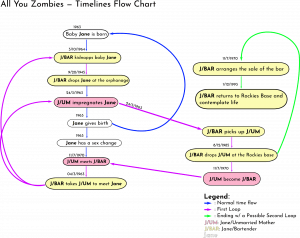
1. On September 20, 1945, the Bartender drops off baby Jane at an orphanage. She grows up there. She dreams of joining one of the “comfort organizations” dedicated to providing R&R for spacemen.
2. Nearly 18 years later, the man who refers to himself as “an unmarried mother” is dropped off at April 3, 1963, by the Bartender. He meets and, after some weeks of dating, seduces and impregnates the 17-year-old Jane, who has an intersex condition. From Jane’s point of view, he then disappears. Actually, he has been retrieved by the Bartender, and taken to 1985 (see sixth bullet point).
3. Jane learns that she is pregnant by the now-missing unknown man. After giving birth by C-section, she is found to be a “true hermaphrodite” who has been severely damaged by the pregnancy and birth; on waking she learns that she has been subjected (without her consent) to a “sex change” which reassigns her sex to male.
4. On March 10, 1964, the Bartender kidnaps the baby and takes it back in time to the orphanage (see first bullet point). Jane, now male, becomes a stenographer, and then a writer. Whenever he is asked his occupation, he replies, somewhat truculently, “I’m an unmarried mother—at four cents a word. I write confession stories.” He becomes a regular at the bar where the narrator, the Bartender, works, but does not interact with him significantly for six years.
5. On November 7, 1970, the Bartender meets the Unmarried Mother, yells at the customer playing “I’m My Own Grandpa“, conducts the Unmarried Mother into the back office, and takes him back to 1963 to “find” (and, ostensibly, get revenge upon) the man who got him pregnant (see second bullet point). He returns to the bar, seconds after going into the back room, and allows the customer to play the song. From his own point of view, he has carried out his mission of ensuring his own existence.
6. On August 12, 1985, the Bartender travels to 1963 and retrieves the Unmarried Mother — whom he had left there (then?) during the events of the fifth (and second) bullet point(s) — to the Rockies base and enlists him (actually a younger version of himself) in the Temporal Bureau.
7. On January 12, 1993, the Bartender, who is also Jane/mother/father/Unmarried Mother, arrives back at his base from 1970 to think about his life.
Monday, April 25th
Let’s finish “Needle in a Timestack” today and you can work on the reader response that should be due by the end of the day. I will go over the rules of a formal reader response. Here are the questions again. This is based on what we call an ‘inquiry’ where you’re inquiring about what it is the story can offer you – what larger truths can be found in a silly little fiction story.
- Do you like or dislike the text?
- Do you agree or disagree with the writer?
- Does the text clash with your personal views?
- How does the text relate to you personally?
- To what extent did the text challenge or change your opinions or beliefs?
- Did you learn anything from the text? If so, what did you learn?
- What is your overall reaction to the text?
Thursday, April 21st
Here’s the Musical Mondays sign up sheet:
We will have the discussion of A Sound of Thunder first, then will start our next story:
So by now, I’m sure you’re aware that if one changes even the slightest thing in the past, then the consequences could be dire.
This next story is one that is similar in theory, but has a few differences. Basically, it’s about a jealous ex-boyfriend trying to mess up a happy marriage by trying to erase the married couple’s past. Pretty cool idea.
Yet this is the day I will teach you about “reader Response. Look at this graphic I stole of the internet:
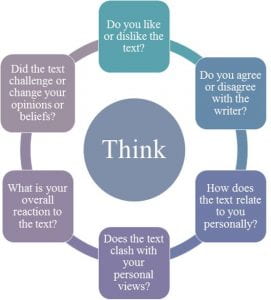
So I will put down these questions that are in the graphic – please write out in a 1-3 paragraph response your reaction to this text after you finish reading it:
- Do you like or dislike the text?
- Do you agree or disagree with the writer?
- Does the text clash with your personal views?
- How does the text relate to you personally?
- To what extent did the text challenge or change your opinions or beliefs?
- Did you learn anything from the text? If so, what did you learn?
- What is your overall reaction to the text?
For the discussion, you are to look back at the response you have just written and come up with a claim (thesis) summarizing everything you’ve written.
Example: You wrote about how both Mikkelsen and Janine are both fighting to keep their love in tact. So you can summarize with “Love is seen of as fleeting, yet something worth fighting for in Silverberg’s “Needle in a Timestack.”
Tuesday, April 19th / Wednesday April 20th
I will read for you this short story. Please read along with me.
We will do a pre / during / post reading of this text in a worksheet.
Here is the story:
Here is the worksheet. It is due tomorrow at midnight.
I am excited to publish the new unit: Time Travel.
Today, we will take it rather easily. We’re going to have a discussion on what Science Fiction genres are.
Here is a run down of what we will be doing –
V3.5_21_Time Travel Short Fiction Introduction
Discussion Questions: (Write, then discuss with a partner)
- What is the definition of Science Fiction?
- What are some examples of science fiction stories? (Movies, Manga, Fiction etc.)
- Is science fiction an effective genre? Why or why not?
- What sub-genres of science fiction can you think of?
On Wednesday, we will be starting a short story that might hurt your brain.
The short stories I have chosen for this specific unit are ordered and as follows:
A Sound of Thunder
Needle in a Timestack
All You Zombies
The Seventh Voyage
Yesterday Was Monday
And if we have time: This is one of the academic skills I want you to take away:
Thursday, April 14th
We will go over journals today. I think that there are a few proposals that still need to be written. This is the day for you to complete as much as you can before you go on your long weekend.
Ask me if you have any questions.
Wednesday, April 13th
Part 1: For the first 30 – 45 minutes, you will find a quiet place to complete your podcast ‘conversations’ – the ones you planned yesterday. Get it done, minor edits for clarity, and turn it in by Thursday 11:59PM
Part 2: Finish your proposal by tonight at midnight. Commit to your final project.
Tuesday, April 12th
Your independent book should be completed by today. I hope you have brought it.
This is an overview I will go over with you again. This document shapes our week this week.
11 – 12 Independent Reading Project
The first task, and I don’t mind if this goes through to tomorrow, is to create a raw podcast of sorts with others who have the same questions as you. These are the questions I would like to give you about 20 minutes by yourself to jot down answers to. Then I will put you in ‘proximity groups’ so that you can record your conversations.
Here are the questions:
Independent book questions podcast V3
Monday, April 11th
FINAL GUIDELINES: Musical Mondays Final guidelines
This class is to create an outline for your final. This is where you ask questions. Your outline is due at the end of class. It is a participation mark.
FINAL ASSIGNMENT: TT-Final-Practice
Musical Mondays Final Presentation Guide
Now that you’ve seen six different styles of how musical genres and themes can be connected, it’s your turn to come up with a final presentation and paper that is a culmination of all the connective tissue of writing and presenting in class. I will list them for you.
- Literary Lenses
- Literary Analysis
- Musical / Poetry Analysis
- Creativity
- Reader Response Evaluation
Today is the first day of your preparation for the final. Here are some things you need to do so that when you write your paper, you will have all of the necessary evidence and prerequisites.
There are two parts to the final. You will be graded as a group.
Part 1 – Paper guidelines (Do this first):
Critical response multi-paragraphs do not simply summarize the text or evaluate whether you like the text; they are a three paragraphs, persuasive, and focused analysis, argument, or interpretation about the text. They not only help you think critically about the texts you read but also help you formulate ideas that can be expanded into longer essays. There are four parts to a critical response multi-paragraph:
You will be doing your own analysis / question and answer on lyrics or musical elements. I would like to see the outline (which are the questions I’ve been making you do for seven weeks) and a final paper that is well polished with a thesis and topic sentences with evidence from the songs themselves.
1) an argumentative topic sentence,
2) evidence in the form of quotations or paraphrases for the argument you are making,
3) interpretation of your evidence in relation to the argument, and
4) a strong concluding statement.
Note: This is a review and collaboration of your lens paragraphs and reader responses – an extended idea that is fully developed and flows well.
Questions for Consideration (Data for Response) TODAY:
- Do you like this song, why or why not?
- What do you think is the most important line and what stands out to you?
- Can you make a connection to your personal life with this song?
- What does this song mean to you?
- What do you think the theme of this song is and why?
- When listening to the song, what mood did it put you in and do you think that it was intended?
- What makes this song so appealing and why was it a hit when it was released?
- How important are the lyrics? Would this make a good instrumental?
- How do we think this song relates to the artist’s personal life?
Part 2: Presentation guidelines
Follow these directions in a PPT / Presentation:
Before you play the song – discuss this / present this to the audience:
- What is your song?
- What Genre is your song?
- Explain the lyrics of the song
- Hand in your written paper to me (see above, example below)
- Play the song
- Hand out discussion questions
- Discuss
- Provide everyone with a final ‘takeaway statement’
Thursday, April 7th
This class is a work block (one of 2) where you get to finalize your essays. Please use this time to your advantage. If you do want to work on other things, I will ask you to go to the library to do so.
Wednesday, April 6th
Today, you will be working on a peer review on the rough draft you turned in last night / this morning.
This is the peer review sheet along with the rubric I will be using for your final papers.
Peer Review 3PP Essay Structure
You have the class today to do a peer review and apply these changes directly to your good copy. Make use of your time. You have through Friday to finish, but put your best effort into the final result.
Tuesday, April 5th
What is the purpose of a chosen cinematic element (lighting / sound/ camera/ editing) in Robert Zemeckis’ Back to the Future, and how does it add to the film’s theme? Use reasons and specific evidence to support your answer.
Once again, you should be working on this essay today. By the end of the class, I would like for you to have a working first draft. Keep checking with me and I will tell you if you’re on the right track or not. Here is the information again:
Literary-3-Paragraph-Specific-OutlineDownload
This is for specific areas in which you need help for your writing. This resource is fantastic for brushing up on grammar, punctuation and writing skills. We will look at this during the week.
https://media.openschool.bc.ca/osbcmedia/english_10v5/wotr/
Step 1.
Fill out this section. Your thesis is what will drive the 1-3PP essay:
Robert Zemeckis in Back to the Future I, uses _____________________________ in order
Cinematic element
to ____________________________________________________________________.
Achieve what purpose
For example,____________________________________________________________.
Provide evidence from the text to support the topic sentence.
_______________________________________________________________________.
________________________________________________________________________
_______________________________________________________________________.
________________________________________________________________________
_______________________________________________________________________
________________________________________________________________________.
Reflective commentary
_______________________________________________________________________.
Sentence of closure/summary
You are to work with what notes you have to come up with a cohesive paper that is a representation of your learning of the terminology and of the analytical paragraphs you have worked on up until this point.
Another way of looking at this is to think about the lens paragraphs you had for the last major assignment and then apply it to this paper – as they are both “Literary Analysis” papers.
Like any model for composition, this is open to criticism. For instance, these paragraphs tend to become formulaic and predictable in structure. Excellent paragraphs, certainly, don’t always follow this or any guide. This guide might help, however, especially in the beginning stages of writing about literature.
Monday, April 4th
This is the last focused Musical Mondays. I am proud to say that this has been the most fun to research out of all the units so far.
The LGBTQ community (and I use an abbreviated acronym to specify the types of music we will be focusing on) has flourished over the past twenty years, and rightfully so. Yet the movement has had a dark history of oppression and bigotry committed against them. We will look briefly at the past hundred years up to contemporary society on a group that has shaped and shaken the musical world for the better.
I do not have the time to go over some of the names you haven’t heard of (Tony Jackson – pioneer of barbershop!) I have given some of the biggest names that you might know through popular movies, musical media, word of mouth or streaming platforms.
https://www.youtube.com/watch?v=yRyaUcVfhak
Ma Rainey – Prove it on me Blues
Ma Rainey was the first blues singer to admit and flourish in her sexual preference. She was a mover and shaker in the blues movement that would become mainstream and not just what people would call ‘race music’ (instead of just music!) back in the 1920’s. Now she is remembered as an icon of the LGBT movement in music and in fearlessness for being true to herself. Her music transcends what public opinion thought about gender, class, and race during the time – which was, shall we say, unenlightened.
Elton John – Tiny Dancer
https://www.youtube.com/watch?v=0FjWM9VasZw
Elton John is an icon, and most people know that he is a household name. In 1976 he came out as gay. This was an excellent moment for the LGBTQ community, as he helped form Glam rock, glam pop and an entire generation of people that became more accepting of the community as a mainstream multi-million dollar money making genre.
David bowie – Starman
https://www.youtube.com/watch?v=sI66hcu9fIs
David Bowie was a mover and shaker of the generation. He changed the voice of ‘pop’ and made experimental pieces while wearing amazing costumes. He created the androgynous look – where the binaries of male and female blurred. He classed himself as bisexual, even though he was married for a long time.
Lady Gaga – “Queer Icon of a generation” Born this way
https://www.youtube.com/watch?v=wV1FrqwZyKw
Lady Gaga needs no introduction. A lot of people do not know (or at least I didn’t) that Lady Gaga identifies as a bisexual female. She is the new form of a diva – a larger than life star that crosses all boundaries. Look at the lyrics and figure out how she expresses herself.
Todrick Hall – Nails, hair, hips, heels
https://www.youtube.com/watch?v=TQ04gPb4LlY
This is just a fun song. Todrick Hall is openly gay. He parodies earlier songs that have defined the LGBT community in song. He continues the old tradition of ‘drag’ or as it was tragically called in the 1930’s the ‘pansy’ art form and reimagines the genre. David Bowie is an obvious influence. He got his big break in American Idol season 8.
Tyler the Creator – Garden Shed
https://www.youtube.com/watch?v=GlZvpRby9Fs
I must bring in Tyler the creator because not only is this song – garden Shed a very well put together and lyrically gorgeous piece, but he’s actually dating Will Smith’s son now, Jayden Smith. A little celebrity gossip never hurt anyone. Also, the R&B / Hip Hop genre, usually a heterosexual affair, has a voice from the LGBT community with this artist. This song in particular is an excellent coming out song.
Questions for Consideration
- What makes music ‘queer’?
- A lot of music is based on a retaliation to oppression of certain cultures or subcultures that go against popular opinion. How is music an expression of self in this vein?
- Why do we like to categorize music? How is this harmful or beneficial to modern culture?
- What examples can you give of multi-genre or ‘undefinable’ music?
- Find a song that is part of what one can categorize as part of the LGBTQ community. Why did you choose this song in particular? (You can choose one of the songs presented today and look at the deeper meanings. Explain.)
Write a poem that has a hidden message. Give hints to what the message is.
Friday, April 1st
Optional Thesis Statements
- In Back to the Future, Zemeckis uses specific camera angles and framing techniques to highlight the different power-dynamics and project emotion onto the audience.
- In Back to the Future, Zemeckis uses editing techniques to show the urgency of time the characters face throughout the film.
- In Zemeckis’ Back to the Future, the lighting demonstrates different lighting techniques to enhance the characteristics of the protagonists.
- Robert Zemeckis’s Back to the Future 1 utilizes camera movement to draw in the audience and provide maximum engagement by emphasizing the expressions and actions of each character, while simultaneously adding more depth to the plot of the film.
- Robert Zemeckis in Back to the Future I(one), use both Diegetic & non- Diegetic sounds in order to create anticipation or inform us of coming events and create an emotional connection from character to audience.
Optional Thesis Statements:
- Zemeckis in Back to the Future shows Editing techniques in order to portray Marty McFly’s actions and their consequences in the past. __________
- Zemeckis in Back to the Future shows sound in order to draw in the attention of the audience for the entirety of the film.
- Zemeckis in Back to the Future shows Lighting in order to enhance the personalities of the characters in the film.
- Zemeckis in Back to the Future shows camera movement in order to accentuate the characters struggles and triumphs as well as make the message of the film clearer.
- Zemeckis in Back to the Future shows camera angles to show the power differences between characters and display the main focuses on this power structure throughout each scene.
We have now finished the movie. We will do this paper in steps. First, I will go over a little about essay structure, so you’re not completely lost.
Literary-3-Paragraph-Specific-OutlineDownload
This is for specific areas in which you need help for your writing. This resource is fantastic for brushing up on grammar, punctuation and writing skills. We will look at this during the week.
https://media.openschool.bc.ca/osbcmedia/english_10v5/wotr/
Step 1.
Fill out this section. Your thesis is what will drive the 1-3PP essay:
Robert Zemeckis in Back to the Future I, uses _____________________________ in order
Cinematic element
to ____________________________________________________________________.
Achieve what purpose
For example,____________________________________________________________.
Provide evidence from the text to support the topic sentence.
_______________________________________________________________________.
________________________________________________________________________
_______________________________________________________________________.
________________________________________________________________________
_______________________________________________________________________
________________________________________________________________________.
Reflective commentary
_______________________________________________________________________.
Sentence of closure/summary
You are to work with what notes you have to come up with a cohesive paper that is a representation of your learning of the terminology and of the analytical paragraphs you have worked on up until this point.
Another way of looking at this is to think about the lens paragraphs you had for the last major assignment and then apply it to this paper – as they are both “Literary Analysis” papers.
Like any model for composition, this is open to criticism. For instance, these paragraphs tend to become formulaic and predictable in structure. Excellent paragraphs, certainly, don’t always follow this or any guide. This guide might help, however, especially in the beginning stages of writing about literature.
Thursday, March 31st
Back to the Future Part 1 take 3
We are at 1:14:28
Final group meetings today before the end of the movie and I’ll then tell you the next step. We will finish the movie today.
LIGHTING: Mac, Colton, Jonathan, Renee, Athena
SOUND: Armaan, Ariana, Aaron, Bella
CAMERA FRAMING/ ANGLES : Jason, Rihanna, Mavis, Lydia, Abigail
EDITING: Schuyler, Jack, Ilya, Michael
CAMERA MOVEMENT: Timothy, Daniel, Hasara, Holly, Davis
Wednesday, March 30th
Back to the future part 1 take 2.
We are at 31:42
Here are the groups. You did very well yesterday.
LIGHTING: Mac, Colton, Jonathan, Renee, Athena
SOUND: Armaan, Ariana, Aaron, Bella
CAMERA FRAMING/ ANGLES : Jason, Rihanna, Mavis, Lydia, Abigail
EDITING: Schuyler, Jack, Ilya, Michael
CAMERA MOVEMENT: Timothy, Daniel, Hasara, Holly, Davis
Tuesday, March 29th
You have been working continually with the film terminology for a week now. These words should come to you more naturally.
I need expert groups for the next three days. You’ll only work with one element and share your work with other groups (jigsaw style).
LIGHTING:
SOUND:
CAMERA ANGLES / MOVEMENT:
EDITING:
FRAMING:
We are starting Back to the Future today. The class schedule will be strict for the next week and as follows:
- Tuesday: 40 minutes watch – Meet in expert groups & share / runner shares with other groups.
- Wednesday: 40 minutes watch – meet in expert groups & share / runner shares with other groups.
- Thursday: 30 minutes watch – meet in expert groups & share / runner shares with other groups.
- Friday: With now acquired data, come up with a 3 paragraph (1000 word approx.) paper on what bigger themes are achieved with your specific expert group element of cinema. (See structure in film package)
Here is the script to Back to the Future:
Monday: Finish the paper – Turn in paper and film package by the end of class.
Monday, March 28th
Welcome back. I have almost finished the LGBTQ musical mondays, but not quite. That will be next Monday. Here is the second to last one before the final practice. This one is called “narrative in song.”
Musical Mondays #3
Narrative in Song
Every song has a story to tell. Yet some stories are better than others. The artist actually has a narrative in mind when they write the thing, so what we have as listeners is a fully fleshed out story, characters, rising action, climax, the lot. The following four songs have stories to tell. It’s your job to understand what the plot is. Then at the end of the analysis, you are to write your own lyric based on the prompt given.
Choose 1! I will quickly play all five.
A Day in the Life – The Beatles
Led Zeppelin – Stairway to Heaven
https://genius.com/Led-zeppelin-stairway-to-heaven-lyrics
Stan – Eminem (Clean)
Thriller – by Michael Jackson
https://genius.com/albums/Michael-jackson/Thriller
You Don’t know my Name – Alicia Keys
Your Task:
- What is the story about? Give a summary of the story as you understand it.
- What is the effect of this story as a song? How do the lyrics and sound combine to make a cohesive whole?
- Now that you know a little bit about narrative stories in general, how is a short story different from a lyrical story? What are the pros and cons of both?
- Put the idea you came up with on your timelines into a lyrical narrative:
Complete the following document by Tuesday at 11:59PM (March 29th) for a minor letter grade.
Thursday, March 10th + Friday March 11th
15 minutes independent reading. (2 Part day – continues into Friday)
Time to work on journals on Friday for 15 minutes.
Please open your film unit packages. I will show you where to go.
- Meet Joe Black (2 times with and without sound)
- Apocalypse now (With sound / without sound)
Complete the questions for Meet Joe Black. We will talk about them on Friday.
Everything will be in here. You should have already completed your survey.
This part of the unit will be an application of your film terminology understanding. This is a pre-requisite for the big project. Back to the Future.
We will start Back to the Future on after I put you in what we call “expert Groups”. These groups will be random. This is after break.
The groups we will come up with today:
FRAMING / ANGLES
LIGHTING
CAMERA MOVEMENT
MUSIC / SOUND
EDITING
Wednesday, March 9th
This is a day of getting prepared for those presentations. I will give you time in class after silent reading. You will present today, both in small groups and a few people will present for the larger group. I really want you to hear these words as much as possible before we jump into the actual project.
Tuesday, March 8th
Today is a day to work on the film terminology project. What is it?
We will go over shots. Here is a video we will watch:
Your exercise will be to find a clip from your favorite movie and show me some of these vocabulary words explained.
This is what you will be doing:
- Finalize your work, get everything set up for small group presentations.
- Each group / individual will present their movie clip and explain what shots / angles / sound / editing / movement they found in the clip. I will walk around as this is going on.
- I will pick five strong groups to present in front of the class. These groups will get an extra percentage point for when they need it in future assignments.
- By the end of class, you should know these vocabulary words, so when we get to Wednesday, we will have experts in the class.
- This is a completion grade. You get an A for showing your knowledge of the terminology regarding film.
Here is the film terminology sheet just in case for your review:
Monday, March 7th
Musical Mondays #2
Songs that Define a Generation
Every generation has an anthem or song that defines them. Music, as we’ve found out, is subjective and personal. Yet there are some songs, factoring in where those songs were played, (For example – an American wouldn’t think that the Korean song “Come Back Home” by Seotaiji would define their American cultural experience in the 1990’s) contribute very heavily to the generation it was played.
I have touched upon North American generational connections from 1968-2004 for this assignment. After 2004, I stopped caring because I moved away:
- Say it loud, I’m Black and Proud – James Brown 1968
https://www.youtube.com/watch?v=j0A_N-wmiMo
- God Save the Queen – Sex Pistols 1976
https://www.youtube.com/watch?v=RvMxqcgBhWQ
- Don’t You Forget about Me – Simple Minds 1985
https://www.youtube.com/watch?v=CdqoNKCCt7A
- Fight the Power – Public Enemy – 1989
https://www.youtube.com/watch?v=mmo3HFa2vjg
- Smells Like Teen Spirit – Nirvana 1991
https://www.youtube.com/watch?v=hTWKbfoikeg
- Hey Ya _Outcast 2003
https://www.youtube.com/watch?v=PWgvGjAhvIw
These seven songs are not the definitive voice of a 35-year period, but their lyrics were cutting edge; the songs themselves were completely new and fresh, daring and authentic.
Your job is to look for a connection between self and society. What is the song of your generation? Go through these questions for the criteria to be met:
- Describe your generation in five descriptive words (Adjectives).
- What is the music that you and your peers are into (if anything?) Who are your heroes? What is ‘popular’ now currently? How has that changed from your past? As a contrast, what is uncool? Be as specific as possible.
- Focus on other areas of popular media (the collective) that have to do with your generation. What are they? Why are they important to you and your friends?
- Create a slogan (phrase that is marketable) for your generation.
A. Example: We don’t care about your rules! Freedom unites us all!
- Choose a song that is an emblem (guidepost) for your generation OR goes with the slogan you’ve just created. Analyze that song using the “Tuneful Tuesday Generic Questions” (Part B)
Friday, March 4th
New Unit!
This is everything you will need for the unit:
At the end of the unit, all you will do is turn in this package – fully completed. The thing is, I will guide you through each page. I am not going to tell you exactly how long it will take us, but it has taken usually about a week and a half for other classes.
I will constantly update this page and explain what we have done. There will be other minor assignments and completion checks that will be due throughout the unit as well. Please keep up with this, as each part makes up a whole.
The unit itself is a perfect bridge for us to jump into our sci-fi short story unit. It is also a chance for you to review analytical paragraphs.
Film Terminology:
We will go over shots. Here is a video we will watch:
Your exercise will be to find a clip from your favorite movie and show me some of these vocabulary words explained.
Thursday, March 3rd
Today is the final day for the narratives. We’re starting on something completely new tomorrow, so get ready for that.
I have a few people I need to talk to, so, please get this done as quietly as possible. I will open a teams assignment folder for you to submit your work.
Good luck, and please use your time wisely.
Wednesday, March 2nd
Today, you should have a narrative non-fiction piece that is ready for people to read. If the story is too personal for peers, I will read it myself.
You will have today and tomorrow to work on the narratives – good copy is due tomorrow (as promised) at midnight.
Friday, we will start the ‘film as literature’ unit.
Tuesday, March 1st
Narrative Essay Outline_Student
I will be absent today. Please make Mr. Spagnuolo feel welcome. This is a work block for you to complete your rough drafts. Tomorrow, we will be working on peer edits and on Thursday, there will be a lot of time to work on your final drafts.
If you want to see what the peer review sheets are like, I will post them here:
An actual outline is impossible for a narrative non-fiction. That’s what makes the writing form so great. On Wednesday, I will post some of my favorites.
Have a great day!!
Monday, February 28th
New Term Long Unit! (Only on Mondays)
Here is the homework sheet that you will be using each week to explore each of the songs. I will have two for you to complete. This is the .doc you’ll be using for each lesson:
When you analyze a piece for perceptive reasons, then the basic questions asked are the ones that seem simple, but provide evidence for good discussion.
WEEK 1:
MUSICAL MONDAYS #1
Alternative rock came about in the 90’s. Some of you might have heard about it , some not. I am giving you three songs that had their moment in the sun, then passed away. These are one hit wonders – in my own time growing up. We love songs then hate them after some time has passed. These songs were some of those songs for my generation.
DISCUSSION QUESTION: Why do we hate songs we once loved? What is over-saturation? Think deeper than ‘ it got boring’.
Here are the songs. The rest of the day is normal. We’ll discuss them during and after you finish the work:
Here’s something to do before you finish the work, however:
- Find song from your past that got ‘over saturated.’ Play it for your people / classroom buddies.
- Discuss these three questions and make sure to be ready to discuss the answers to me personally.
- What made this song old and stale to you? (Besides repetition) Why is it that songs become loved, hated, then loved again?
- What memories does this song invoke?
- Are the lyrics even important or is it the beat? Something else entirely? (Nostalgia, aesthetic, etc.)
- Discuss these three questions and make sure to be ready to discuss the answers to me personally.
1.Sugar We’re Going Down – Fall Out Boy
https://genius.com/Fall-out-boy-sugar-were-goin-down-lyrics
2. Marcy’s Playground, Sex and Candy: https://genius.com/Marcy-playground-sex-and-candy-lyrics
- Whetus, Teenage Dirtbag: https://genius.com/Wheatus-teenage-dirtbag-lyrics
Thursday, February 24th
Ask peers, people you trust, and lastly me which seems to be the most interesting part of your timeline. Really think about this, as you will be committing to one of them.
When you commit, begin on this assignment:
Narrative Essay Outline_Student
If we have time after I explain the narrative outline:
Before we start, I would like for you to have a physical artifact and a chosen summary from your timeline.
These are the instructions:
Fragmentary Narrative / Poetry Activity.
- Take your ‘artifact’ out of your bag.
- Put it in the center table
- We’ll do a quick Kinesthetic warm up so you can get rid of your egos.
- Focus on an object for three minutes.
- Quietly go back to your desks, don’t talk to anyone else about anything
- Write for five minutes about the artifact
- Come back into the circle
- One word that comes to mind from your story ‘word ball’
- Go back to your story and circle key words.
- Export these chosen words to another piece of paper and reorder them as a poem
- Share the poem with another person. Discuss the importance of the assignment. (if any).
- Interpretive dance? (Optional – after class when I have left the building.)
So now that you have a “fragmented memory’ from another person’s life that you have considered as your own, you have experienced the reader / writer dichotomy. Every detail is important when one is sharing their own stories. Every detail can be interpreted in a certain way. Once you have finished writing your narrative, it is theoretically no longer yours, but part of what Jung calls “a collective unconscious” – if enough people read it.
What was your takeaway?
Wednesday, February 23rd
We will read another story by Sedaris that I hope you enjoy. Same style. Overcoming adversity. Then we’ll get to the real stuff.
- How does Sedaris use humor and characterization to show growth through having a speech impediment? How does he deal with authority in both stories?
- Explain a time in your life when you have been ashamed of yourself or your actions.
- What quotes can you find in this story that are affecting / resonant? Choose up to three.
I have two documents that I will share with you:
This is what a narrative non-fiction essay looks like – (the elements of)
Ask peers, people you trust, and lastly me which seems to be the most interesting part of your timeline. Really think about this, as you will be committing to one of them.
When you commit, begin on this assignment:
Narrative Essay Outline_Student
Tuesday, February 22nd
I am going to read you a story – non-fiction narrative – called “Me Talk Pretty One Day”.
After we will discuss these three questions that I’d like you to copy in a document and answer.
But first, there’s a poem that I’d like to share, and I’d like for you to write this quote and respond to it:
Refrigerator, 1957
by Thomas Lux
More like a vault — you pull the handle out
and on the shelves: not a lot,
and what there is (a boiled potato
in a bag, a chicken carcass
under foil) looking dispirited,
drained, mugged. This is not
a place to go in hope or hunger.
But, just to the right of the middle
of the middle door shelf, on fire, a lit-from-within red,
heart red, sexual red, wet neon red,
shining red in their liquid, exotic,
aloof, slumming
in such company: a jar
of maraschino cherries. Three-quarters
full, fiery globes, like strippers
at a church social. Maraschino cherries, maraschino,
the only foreign word I knew. Not once
did I see these cherries employed: not
in a drink, nor on top
of a glob of ice cream,
or just pop one in your mouth. Not once.
The same jar there through an entire
childhood of dull dinners — bald meat,
pocked peas and, see above,
boiled potatoes. Maybe
they came over from the old country,
family heirlooms, or were status symbols
bought with a piece of the first paycheck
from a sweatshop,
which beat the pig farm in Bohemia,
handed down from my grandparents
to my parents
to be someday mine,
then my child’s?
They were beautiful
and, if I never ate one,
it was because I knew it might be missed
or because I knew it would not be replaced
and because you do not eat
that which rips your heart with joy.
What is this poem about? Why did I choose this poem for a non-fiction writing unit?
Here is the story:
COPY AND PASTE THESE QUESTIONS:
- How does Sedaris use humor and characterization to come to terms with his fear of learning a new language?
- Explain a time in your life when you have overcome adversity at school or a place of learning?
- What quotes can you find in this story that are affecting / resonant? Choose up to three.
Thursday, February 17th & Friday, February 18th
Independent reading (Both days)
Here is a worksheet for the timeline. I suggest you find or buy a big paper/posterboard to take home as well. All you need to do is look for 10 memories of your past in a linear way. Ask family / friends for ideas.
Don’t worry about trying to understand everything right away. People said to me “Trust the Process” – it was good advice.
Ask the sub to get previous posters from my office desk if you’re stuck. You can use the warm up exercise we did on Wednesday in class for prompts.
Due on Tuesday, February 22nd!!!
I’ll hand back your final lens papers on Wednesday, February 23rd.
Wednesday, February 16th
Independent reading.
Narrative Non-Fiction Unit!
I love this unit. I change it every year. This is a rough version of what your final will look like:
TODAY:
This is a kind of “Speed Writing Challenge” that will be shared with someone in class. These are all random essay questions college boards would ask you during the application process. It is good to familiarize yourself with this kind of essay question before we get into the more ‘fun’ side of narrative non-fiction.
- Please answer two of these questions. I will time you for each. (15 Minutes)
- After three questions, I will ask you to choose the strongest of the two.
- Group discussion of these pieces – what you took from your partner’s work.
You can download the questions here:
V2.5_NarrativePrompt_PreAssess
Narrative Essay Outline_Student
Here is a worksheet for the timeline. I will give you big paper to take home as well. All you need to do is look for 10 memories of your past in a linear way. Ask family / friends for ideas.
Don’t worry about trying to understand everything right away. People said to me “Trust the Process” – it was good advice.
Tuesday, February 15th
Silent reading 10 mins.
Today is a work block for handing in your good copy lens paragraph.
If you do need help from me, then please specify what exactly I can do. Since this is a good draft and you have the feedback from others, I would like you to take your own chances. Check the rubric. Trust your writing instincts.
That being said, I will be available, but only as a helper – not as a tutor today, sadly.
Get that thing turned in by tonight!
Monday, February 14th
Happy Valentines Day.
We will read for a short while – Today is a good day to complete the first journal. I will give you some time in class for that. Here is the document again:
Journal Entries Independent Novel Study: Independent reading Journals
Now, for the remainder of class, I would like you to work with three peers – hopefully people you feel that will give you good feedback – so that you can see the strength and weaknesses of your paper. What you have turned in is good. Shows me that you can do the basic outline. Now you expand your ideas.
This is the Peer review you will be using:
Conventions of Critical Writing Peer REVIEW
The final paper will be due Tuesday at the end of the day.
On Wednesday, we will switch things up with Narrative Non-Fiction. This will go through the following Friday.
Friday, February 11th, 2022
So it’s time to put everything together.
What perspective (lens) shows the major theme of Before Sunrise / Lion King?
Structure you need to follow for final paper: (Copy and paste to a word document)
Rough Draft Due Tonight February 11th at 11:59PM!
The Ten-Sentence Critical Paragraph – A Variation of P.E.E.
Like any model for composition, this is open to criticism. For instance, these paragraphs tend to become formulaic and predictable in structure. Excellent paragraphs, certainly, don’t always follow this or any guide. This guide might help, however, especially in the beginning stages of writing about literature.
Sentence 1 – Topic Sentence – contains the title of the piece of literature, the writer’s full name, and your topic. If this is an answer to an assigned question, then your topic sentence might be a rewording of the question into a statement. (a thesis statement, your statement to prove)
Sentence 2 – Main Point #1, One way the writer does what you say he or she does is through…
Sentence 3 – Example/Reference or quotation #1. The best example from the piece of literature which supports you main idea #1.
Sentence 4 and 5 – The explanation in your own words of how/why this example/quote does what you say it does. This section is where you develop your answer and prove your thesis.
Sentence 6 – Main Point #2. Another way the writer does what you say he or she does is…
Sentence 7 – Example/Reference or quotation #2. The best example from the piece of literature which supports you main idea #2.
Sentence 8 and 9 – The explanation of how/why this example/quote does what you say it does. This section is where you develop your answer and prove your thesis.
Sentence 10– Concluding Sentence. Minimally: summarize your paragraph repeating some of the key words from the question. Better: relate this literary device/technique to the effectiveness of the whole composition and how the device/technique helps the author develop the theme, or, relate the composition’s theme to real life.
| Remember the Conventions of Critical Writing (writing about literature) – Verbs should be in Present Tense – Use Objective Point of View (no ‘I’ statements) – It’s not simply your opinion. You are making a plausible interpretation of a writer’s work. – A quote should not sit as a sentence. A quote should become part of your sentence. – convey, portray, depict, evoke, and any literary term… are good words to use! – Refer to the reader, the writer, the speaker |
Transcript of The Lion King
https://lionking.org/scripts/Script.html
Transcript of Before Sunrise:
Let me know when you need help.
In [Richard Linklater’s film Before Sunset,] the theme of _________________ is shown through [the character’s discussion] of __________________________________________________________ .
A major frame of the film would be seen through a ________________ lens.
This is exemplified / explored / shown / highlighted because _________________________________________________________________________________________________________________________________.
Remember:
Theme / Lens / Evidence / Explanation / Evidence / Explanation / Conclusion
You have the rest of class to ask questions about the final paragraph. (Thursday / Friday) The final paragraph will be due Monday. You have class today to get everything sorted out. You have half of the class tomorrow to write the final.
THIS IS THE RUBRIC FOR THE LENS PARAGRAPH: (also on Teams)
Monday – Tuesday (February 7-8)
INDEPENDENT READING PROJECT INFORMATION:
Library for 20-30 mins at the beginning of class. (Monday) Independent Novel Study Project
Information on Independent Novel Project:
What is the independent Novel Study Project?
Here is the project:
Independent Project Final_2021
And here is the rubric:
Novel-Study-Project-Rubric-2018
And here is the journal for Independent reading:
February 3rd, Friday
Today, we will finish the mini lenses presentations and then we will watch something completely other that what I had planned.
How I met your mother is no longer available to stream. The second, newer show I was to present – that 70’s show is no longer available to stream.
So I have gone back to the original show I loved in the 90’s and have researched it through a Psychoanalytical lens to get you thinking about what you can write:
The Simpsons.
Here is the script of the show:
https://www.simpsonsarchive.com/episodes/3F05.html
And we will briefly look at a part of an undergraduate thesis from someone who studied in the University of Iceland. Luckily, it was on The Simpsons and lenses… but how they look a little later down the academic road. We’ll discuss it:
EXCERPT:
2.1 The Pleasure Principle in “King-Size Homer”
In the seventh episode of the seventh season of The Simpsons, Homer strives to obey the
pleasure principle to new extremes. In a mandatory five minute session of calisthenics at
the Nuclear Power Plant, Homer finds out that one of his co-workers got injured on the
job and is now on disability with full pay. Upon hearing the news, Homer immediately
decides to get himself injured enough to become disabled so he can work from home.
Unable to harm himself, he realizes that hyper obesity can qualify him as disabled. He
consults Doctor Nick Riviera, who recommends “a slow steady gorging process
combined with assal horizontology” and that Homer focuses “on the neglected food
groups such as the whipped group, the congealed group and the chocotastic.” With help
from Bart, Homer begins his mission of overeating himself into obesity.
This is obviously not a good idea; however, Homer is regulated by the pleasure
principle, which entails that when confronted with pain he finds the easiest way to
relieve himself of it (Freud, Beyond 1). Freud explained: “The pleasure principle, then,
is a tendency operating in the service of a function whose business it is to free the
mental apparatus entirely from excitation or to keep the amount of excitation in it
constant or to keep it as low as possible” (Beyond 56).
For Homer, his job is the excitation and the id strives to have Homer away from
the Nuclear Power Plant at all costs. This explains partly why Homer has dipped his toe
in so many fields of professions; while the job is new and exciting in itself, it does not
cause pain. However, Homer‟s attention span only lasts so long and he quickly becomes
bored. Being on disability is the perfect choice for Homer‟s pleasure principle regulated
mental process. Instead of seeking new jobs, which all end in causing pain instead of
pleasure, he gets to be at home—which means, in his mind, being able to drink beer and
frolic with Marge at will. The ends justify the means, even if it is dangerous for his
health and immoral, since becoming disabled on purpose is abusing the system.
Confronted by Lisa about this morality issue and whether he has told Marge about
his plans, Homer answers:
I‟m not saying it isn‟t sleazy, honey, but try to see it my way: all my life I‟ve been
an obese man trapped inside a fat man‟s body. … No, it would only worry
[Marge]. If you want to add to her worries, go ahead. I guess I‟m just a little more
grateful for all the things she‟s done for us.
Unlike the ego, which tries to be moral, and the superego, that can be super-moral, the
id is non-moral (Freud, The ego 44). For Homer it is not morally wrong to answer his
eight year old daughter like that, neither is becoming disabled due to obesity. There is
really no right or wrong in the id, no contradictions or conflicts—there is only the
instinctual strive for pleasure (Freud, “The Question” 196, 201). Obviously, the ego
needs to step in and Lisa is surprised on how long Marge is willing to let this go on. She
needs “to mediate between the claims of the id and the objections of the external world”
(Freud, “The Question” 201). In this case the claims of the id are being obese and, quite
frankly, lazy while the external world objects with ridicule. Unlike the id, the ego goes
by the reality principle, which “takes into account the conditions imposed by the real
external world” (201) and the difference between the reality principle and the pleasure
principle shines through when Marge finally confronts Homer:
MARGE. Let‟s quietly and calmly discuss the pros and cons of your controversial
plan, shall we?
HOMER. I …
MARGE. Con! You‟re endangering your health.
HOMER. Pro. I‟m drought-and famine-resistant.
MARGE. Con! You‟re setting a bad example for the children.
HOMER. Pro. I, er, don‟t have to go to work.
MARGE. Con! You‟re running the air conditioner non-stop. It‟s freezing in here.
HOMER. Pro. Uh… uh… I love you?
MARGE. Con. I‟m finding myself less attracted to you physically.
The ego’s intervention is too feeble, too late. Utterly disconnected with reality, Homer
exclaims that this is everything he ever wanted and now, he finally is a “big fat
dynamo.” He now works from home and for Homer that is enough. Of course, his
happiness based on a change of scenery lasts only a few hours and although he does not
have to face the morning traffic, he does have to succumb to the boredom of sitting in
front of a computer all day pressing Y for Yes, N for No and Tab for ordering the soft
drink TAB. To be fair, his job as a Nuclear Safety Inspector never seemed to require as
much attention while he worked at the plant itself. Now, he has to actively take
decisions over and over again on serious matters like venting gas to prevent explosions.
Even when confronted with this critical task, he fails to realize the impact of his deeds.
He begins answering every question with “Yes,” casually using a broom so he does not
have to leave the couch, and when that becomes too much of a chore, he puts a toy in
charge—a drinking bird that bobs its head up and down in perpetual motion. He literally
risks a nuclear meltdown, so dire is his need for pleasure. He leaves the confinements of
his home/workplace, sporting his new flowery muumuu, cape and his fat guy hat.
While outside, in the real world, he is confronted by the ridicule that was
expected. He tries to see a film (“Honk if you‟re horny”) but loses his dignity when the
cinema‟s manager explains that the seats cannot take a man of his girth and offers him a
garbage bag full of popcorn if he does not make a scene. Homer hurries home and
decides that it is up to him to show the world that the obese are not lazy and
irresponsible, only to find that while away, the bird failed and an explosion is imminent.
In the end, of course, he redeems himself by saving the day; however, the only reason
why he is adamant enough to do so is because an explosion would cause him personal
pain. “Everybody‟s going to be dead, especially me!”
END OF EXCERPT
Let’s think about these three questions:
- What lens best represents the episode and why?
- What two pieces of evidence can you find (in the transcript or your notes) that backs up this lens?
- What does this mean as a ‘bigger picture’? For example – what can we take away and learn from this episode?
First, you can have a discussion with partners, and then begin to make a good idea of this in your writing. Make sure to answer the questions based on the lens you have chosen. I will hand out a paper that is a matrix of lenses so that it can help you. This will also be used for the full length film
.Introduction-to-Literary-Theory-Grid-Grade-10.11Download
This informal paragraph is due next Tuesday at 11:59PM. You have part of Monday and all Tuesday to complete the assignment.
:
February 1st – 3rd (Tuesday – Friday)
Welcome to class.
Here’s the syllabus. Let’s go over it briefly. Each pair should come up with a question that you need clarified.
Here’s the introduction to the unit:
10 Essential Questions (out of 100)
https://www.signupgenius.com/groups/getting-to-know-you-questions.cfm
- Brainstorm with class on questions
- Find someone you don’t know
- Ask 10 of the questions from the board – answer them – Vice versa
- Get ready to present your partner to the class
Let’s get started.
Now, things might get a little strange right away, but I’d like for you to take notes on this video to reflect on the content. I’ll hand out paper.
- Structuralism:the significance of the changing balance between text and image and its relationship to an interpretation of the story as a fantasy – a figment of Max’s imagination, oppositions.
b. Feminism: the role of the mother (and the absence of the father), the balance of power between mother and son, the role Max adopts with the ‘wild things’, the representation of the ‘wild things’ as gendered or genderless.
c. Postcolonial: the role Max adopts with the ‘wild things’, his colonising – and subsequent desertion – of the creatures, the behaviour of the ‘wild things’, the colour symbolism of Max’s clothing.
d. Psychoanalytic: what the ‘wild things’ might represent, Max’s relationship with his mother, the absence of the father, dream/reality distinctions, sublimation of desires into fantasy.
Look for fairy tales. Either by yourself or with a partner. Pick a lens in which to view your fairytale.
Look at this document. There are 8 lenses to choose from, but you only need to familiarize yourself with four.
Here’s some fables from Aesop etc. you can choose from:
Tomorrow, you’ll present your fairy tale for class. You will do these three things:
- Summarize the fairytale
- tell the class what lens you are looking through and why
- explain why this lens is relevant to the story.