Literary Studies 10
December 18th, 2025
Rough Draft due today for your story.
Rough Draft. (750 words approx.)
This is a work block for you to complete your rough drafts / good drafts / peer review.
GOOD DRAFT DUE TOMORROW DECEMBER 19th AT MIDNIGHT
December 16th, 2025
Reading / Finishing outline
I want you to read this story. I would like you to know how narrative non-fiction can work. The questions for today’s story are due tonight, yet if the discussion is good, this will not have to be the case.
Here is the story:
COPY AND PASTE THESE QUESTIONS:
- How does Sedaris use humor and characterization to come to terms with his fear of learning a new language?
- Explain a time in your life when you have overcome adversity at school or a place of learning?
- What quotes can you find in this story that are affecting / resonant? Choose up to three.
December 15th, 2025
Musical Mondays –
Today and Tomorrow:
Here is a worksheet for the timeline. I will give you big paper to take home as well. All you need to do is look for 10 memories of your past in a linear way. Ask family / friends for ideas.
Reading.
Yes, I want you to read this story. I would like you to know how narrative non-fiction can work. The questions for today’s story are due tonight, yet if the discussion is good, this will not have to be the case.
Here is the story:
COPY AND PASTE THESE QUESTIONS:
- How does Sedaris use humor and characterization to come to terms with his fear of learning a new language?
- Explain a time in your life when you have overcome adversity at school or a place of learning?
- What quotes can you find in this story that are affecting / resonant? Choose up to three.
December 12th, 2025
You have the class to work on this timeline. I’ll give you blank paper to complete the “Good Draft” of this – 10 memories from your childhood to now – as specific as possible, either good or bad!
Here is a worksheet for the timeline. I will give you big paper to take home as well. All you need to do is look for 10 memories of your past in a linear way. Ask family / friends for ideas.
December 11th, 2025
Per 4:
Choose one of your friend’s narrative non fiction free writes – the one you think is strongest – and I’d like you to complete it, using your own memories. I will give you an example of my own. This will seem a little tricky, but creating your own voice from another story is something we’ve been doing since the beginning of time!
Part 2:
Here is a worksheet for the timeline. I will give you big paper to take home as well. All you need to do is look for 10 memories of your past in a linear way. Ask family / friends for ideas.
December 10th, 2025
SPOKEN WORD
If we have time:
This is a kind of “Speed Writing Challenge” that will be shared with someone in class. These are all random essay questions college boards would ask you during the application process. It is good to familiarize yourself with this kind of essay question before we get into the more ‘fun’ side of narrative non-fiction.
- Please answer two of these questions. I will time you for each. (15 Minutes)
- After answering the questions, I will ask you to choose the strongest of the two.
- Group discussion of these pieces – what you took from your partner’s work.
You can download the questions here:
V2.5_NarrativePrompt_PreAssess
Narrative Essay Outline_Student
December 8th, 2025
I hope you had a spoken word filled weekend.
We have MUSICAL MONDAYS today. Let me know who’s going. I know there are a few extra students going.
Then:
Finish off your spoken words. I need your titles today for the MC’s.
December 5th, 2025
A few games for a warm up – this is based on :
- Word Ball
- Sentence ball
- Tone Poet
Continue your spoken word after this is over.
December 4th, 2025
Planning sheets for your spoken word.
By the end of class today, I need a title, a type, and a rough draft. We will use this day to write.
December 3rd, 2025
Spoken Word! – Let’s celebrate by watching a bunch of them before we start.
Story Telling
The Moth: Storytelling Pacing “Shared Thoughts”
Slam Poems: Solo poet
Indigenous Focused
Non Indigenous Poets
https://www.youtube.com/watch?v=ltun92DfnPY&ab_channel=ShaneKoyczan
December 2nd, 2025
Peer review:
I have paper copies as well.
Please have this done by the end of today. The final draft is due tomorrow!
December 1st, 2025
Musical Mondays (Check Teams)
Tonight your rough draft is due for the time travel story. If we have any time after Musical Mondays is over, then please spend it wisely finishing up your drafts. Same rules as Friday apply. Not working = Go for a walk.
November 28th, 2025
Please continue the time travel short story. By the end of class, I want you to turn in your beat sheets and check with me one on one with the progress of your draft.
If you want to be noisy while working, PLEASE LEAVE CLASS!
The beat sheets look like this:
Time Travel Short Story Planner
| 3-Act Time Travel Story Structure | Your Story Plan
|
| ACT I: SETUP Introduce protagonist and normal world. Establish the time travel concept or inciting incident. |
________________________________________ ________________________________________ ________________________________________ ________________________________________ |
| Catalyst The moment that triggers the time travel event or decision. |
________________________________________ ________________________________________ ________________________________________ ________________________________________ |
| Debate Protagonist wrestles with whether to act on or ignore the time travel opportunity. |
________________________________________ ________________________________________ ________________________________________ ________________________________________ |
| ACT II: CONFRONTATION Protagonist enters the new world (past/future/loop). Adjusts to new rules. |
________________________________________ ________________________________________ ________________________________________ ________________________________________ |
| Fun and Games Explores the story’s ‘promise’: paradoxes, changed pasts, glimpses of the future. |
________________________________________ ________________________________________ ________________________________________ ________________________________________ |
| Midpoint A major event or revelation changes everything—stakes rise dramatically. |
________________________________________ ________________________________________ ________________________________________ ________________________________________ |
| Bad Guys Close In Challenges mount. The effects of time travel become problematic. |
________________________________________ ________________________________________ ________________________________________ ________________________________________ |
| ACT III: RESOLUTION Climax—Protagonist must act decisively to fix, accept, or embrace time’s truth. |
________________________________________ ________________________________________ ________________________________________ ________________________________________ |
| Final Image A changed world or character. Reflects the theme of time and personal growth. |
________________________________________ ________________________________________ ________________________________________ ________________________________________ |
November 27th, 2025
Brainstorming:
Seeing the Future
In these stories, it is actually information that travels through time. And this might be the most scientifically plausible form of time travel, one that is already happening all the time on the quantum level.
Visions of the future have shown up in literature and mythology for millennia, it’s just that we used to call them prophecy. But the fundamental storytelling device has changed little, even as it evolved with the times, manifesting in various communication technologies. Characters connect to the future through newspapers (the film It Happened Tomorrow, which inspired the show Early Edition), letters (The Lake House), radio (Frequency), photography (Time Lapse) and now, the Internet.
All these stories of peering forward in time differentiate into two categories on the basis of one crucial question: If you see the future, can you change it?
1a: Stories of Inevitable Foresight
These are stories where the future can be seen—but ultimately, what you see can’t be stopped.
The archetype for this form is one of the oldest works of dramatic literature in the Western canon—Sophocles’ play Oedipus Rex, where the titular king is warned by the seer Tiresias that he will murder his father and wed his mother… and despite his best efforts to the contrary, he ends up inadvertently doing just that (and then gouges his eyes out for good measure).
Stories of inevitable prediction speak to one of our deepest fears: that we have no free will, no agency, no power to control our fate. A glimpse of the future, foreknowledge of what’s to come, only ends up causing the events we aim to prevent.
Sound depressing? Maybe that’s why it’s a theme that spoke to sci-fi author Philip K. Dick, author of Minority Report— which is, for all its superficial differences, a story very similar to Oedipus Rex. It features a trio of precogs who dream of future-murders, and a cop assigned to prevent such killings—until he finds himself accused of one himself.
Dick was a pessimist about the prospect of free will, and in his story (spoiler alert!) his character ends up going through with the predicted murder. But perhaps unsurprisingly, when Steven Spielberg got hold of the same material, the outcome changed, and Tom Cruise’s version of the character was able to alter his destiny. How? Sheer force of movie-star charisma mostly. Which brings us to—
1b: Stories of Preventable Foresight
Other stories of seeing the future treat altering the timeline as quite evitable. In fact, the very act of viewing what’s ahead empowers the individual to change things, and prevent the foreseen events from coming to pass. That’s how Early Edition worked, with Kyla Chandler given the thankless daily task of averting tragedies only he could foresee.
But the prototype for this story form can be traced at least to 1843, in A Christmas Carol. Yes, even Dickens wrote some timey-wimey shenanigans; what else are the Ghosts of Christmas Past and Yet To Come? And when Scrooge beholds the pitiful sight of Tiny Tim dead, and his own neglected grave, he is promised a chance to rewrite the narrative if he can merely change his ways.
Which means that Dickens was much more of an optimist than Sophocles or Philip K. Dick. Being able to see the future and change it, whether through an epiphany or a magical newspaper, is the sort of world most of us want to believe in… whether that’s the way things actually work or not.
But in other types of stories, it’s not only information that travels through time. Many stories concern people getting to do so too—and the way authors treat those journeys says just as much about who they are and how they view the world.
- Traveling to the future
One of the clearest progenitors of the time travel narrative, H.G. Wells’ The Time Machine, is about a man zipping off into the distant future. But the world he encounters—one full of peaceful Eloi and belligerent Morlocks—is so disconnected from our own, it’s hard to know why it’s not simply a story about aliens on another planet.
This points to a problem with time-travel forward. The future feels so unknowable, it often ends up being less interesting than we’d expect. That’s why some “travel into the future” stories make our present the future of the characters—like Time After Time, which features Jack the Ripper fleeing 1890’s London and winding up (via a time-machine that belongs to H.G. Wells) in 1970’s San Francisco (it’s as ridiculous as it sounds, and well worth a watch). But this plot device is really no different from the fish-out-of-water Rip Van Winkle premise, dressed up with technology.
Perhaps this is why “travel into the future” has perhaps been used most effectively as a last-minute twist ending, as in the original Planet of the Apes.
In other words—time-travel into the future is just not that special… maybe because we’re doing it all the time, at a consistent rate of 60 minutes per hour. And given that our own lifetimes have witnessed such seismic changes in technology and society, do we really need to imagine a cosmic leap forward to see things that will blow our minds?
That’s why the most interesting physical-time-travel stories have focused on…
- Traveling to the Past
Some of these stories are just touristy jaunts that don’t bother with the ramifications of intervening in history (like A Connecticut Yankee in King Arthur’s Court). Which is fine and well, but more interesting are stories that grapple with the question: Can we alter the past? And by implication… can we alter our own present? Which breaks the category down into two distinct groups…
3A: Changing History
Perhaps the most intuitive mode of time travel is where characters travel to the past, and in doing so, alter the present they left behind. Back to the Future is probably the most popular of all. It’s fun to meet your teenage parents, but if you mess things up, you risk erasing yourself from existence. So then you have to… fight off your mom’s sexual advances and help your dad save her from getting raped? (Yeah, I didn’t really get how messed-up that was as a kid either…) Fix the past, fix the present, life goes on.
Of course, beyond just keeping your parents married and yourself in the family portrait, what people dream of is using time travel to fix history, the easiest go-to being the plot to kill baby Hitler. But in the massive time travel canon, it’s almost exclusively villains who try to rewrite the past. Very few stories feature heroes changing history for the better. Butterfly effects are almost always negative, and even the most well-intentioned time travel plans (like saving Kennedy from assassination in Stephen King’s 11/22/63) result in horrible misfortune for the world (catastrophic earthquakes in that case, for, ya know, reasons).
All of which points to the fact that on some profound level, as much as our minds love playing with the possibilities of altering the timeline, we are deeply attached to the one we have, and innately suspicious of any effort to correct it. Which is why we have…
3B: Immutable Timelines
Stories where characters find themselves fundamentally incapable of altering history, regardless of their level of intervention. 12 Monkeys (and the French film it’s based on, La Jetee) tells the story of a time traveler seeking to prevent an apocalyptic manmade plague. He ultimately fails and realizes, too late, that as a child he witnessed the death of himself, as an older time traveler. The ending is incredibly satisfying—despite the fact that it’s profoundly fatalistic, suggestive of a world in which not even high-tech time-bending can save the human race from killing itself.
A less fatalistic example of this approach to time-rules is found in Avengers:Endgame, in which the characters travel to various moments throughout Marvel history to steal Infinity Stones (think Oceans 11 with a lot of fan-service). Smart Hulk (yes, seriously) gives the stipulation that history will “heal” itself of their interventions, preserving the timeline. On its face, this sounds like a lame gimme of a screenwriting rule — but turns out, it’s actually reasonably well-supported by recent experiments on quantum time travel. Science and sci-fi both point to the same idea: we can’t change the past.
- Time loop
Which brings us to the final category—the pinnacle of unalterability—stories where a character is stuck reliving the same day again and again. The prototype here is the 1993 comedy Groundhog Day. The formula it set out brilliantly has been replicated in other genres, including but not limited to YA melodrama (Before I Fall), slasher-horror (Happy Death Day), sci-fi action with aliens (Edge of Tomorrow), sci-fi action without aliens (Source Code, ARQ), episodic existential-dramedy (Russian Doll) and then circling all the way back to comedy again in last year’s Palm Springs.
These films don’t merely share a high-concept, they all have essentially the same theme: life doesn’t change until you change. Which would seem to make them remarkably unoriginal, if not for the surprising fact that they’re ALL good. (Seriously, I’ll go to bat for Before I Fall). No doubt there are some bad time-loop movies that I missed, but the fact that one hyper-specific premise has resulted in so many excellent movies points to the fact that there is a deep, resonant truth to the notion of being trapped in time.
Of course, this is only a partial taxonomy of time travel, but even this incomplete catalogue points to a few key takeaways. Most time travel stories are cautionary tales. Attempting to meddle with history is punished; defying prophecy is futile; the best we can do is pull a Marty McFly and close the Pandora’s box we opened in the first place. These stories, for all their far-flung leaps through space and time, are ultimately about how, if we want to change our lived reality, we need to start with ourselves.
Our job is to look through these four types of stories and find a universal truth to why we are obsessed with the notion of time – the true ruler of us all.
NOW: Check out this worksheet:
This is what we’ll do today.
Time Travel Short Story Planner
| 3-Act Time Travel Story Structure | Your Story Plan
|
| ACT I: SETUP Introduce protagonist and normal world. Establish the time travel concept or inciting incident. |
________________________________________ ________________________________________ ________________________________________ ________________________________________ |
| Catalyst The moment that triggers the time travel event or decision. |
________________________________________ ________________________________________ ________________________________________ ________________________________________ |
| Debate Protagonist wrestles with whether to act on or ignore the time travel opportunity. |
________________________________________ ________________________________________ ________________________________________ ________________________________________ |
| ACT II: CONFRONTATION Protagonist enters the new world (past/future/loop). Adjusts to new rules. |
________________________________________ ________________________________________ ________________________________________ ________________________________________ |
| Fun and Games Explores the story’s ‘promise’: paradoxes, changed pasts, glimpses of the future. |
________________________________________ ________________________________________ ________________________________________ ________________________________________ |
| Midpoint A major event or revelation changes everything—stakes rise dramatically. |
________________________________________ ________________________________________ ________________________________________ ________________________________________ |
| Bad Guys Close In Challenges mount. The effects of time travel become problematic. |
________________________________________ ________________________________________ ________________________________________ ________________________________________ |
| ACT III: RESOLUTION Climax—Protagonist must act decisively to fix, accept, or embrace time’s truth. |
________________________________________ ________________________________________ ________________________________________ ________________________________________ |
| Final Image A changed world or character. Reflects the theme of time and personal growth. |
________________________________________ ________________________________________ ________________________________________ ________________________________________ |
November 26th, 2025
In class writing for final reader response.
ALSO – If you’re finished, take a look over these tie travel theories we have discussed together:
Brainstorming:
Seeing the Future
In these stories, it is actually information that travels through time. And this might be the most scientifically plausible form of time travel, one that is already happening all the time on the quantum level.
Visions of the future have shown up in literature and mythology for millennia, it’s just that we used to call them prophecy. But the fundamental storytelling device has changed little, even as it evolved with the times, manifesting in various communication technologies. Characters connect to the future through newspapers (the film It Happened Tomorrow, which inspired the show Early Edition), letters (The Lake House), radio (Frequency), photography (Time Lapse) and now, the Internet.
All these stories of peering forward in time differentiate into two categories on the basis of one crucial question: If you see the future, can you change it?
1a: Stories of Inevitable Foresight
These are stories where the future can be seen—but ultimately, what you see can’t be stopped.
The archetype for this form is one of the oldest works of dramatic literature in the Western canon—Sophocles’ play Oedipus Rex, where the titular king is warned by the seer Tiresias that he will murder his father and wed his mother… and despite his best efforts to the contrary, he ends up inadvertently doing just that (and then gouges his eyes out for good measure).
Stories of inevitable prediction speak to one of our deepest fears: that we have no free will, no agency, no power to control our fate. A glimpse of the future, foreknowledge of what’s to come, only ends up causing the events we aim to prevent.
Sound depressing? Maybe that’s why it’s a theme that spoke to sci-fi author Philip K. Dick, author of Minority Report— which is, for all its superficial differences, a story very similar to Oedipus Rex. It features a trio of precogs who dream of future-murders, and a cop assigned to prevent such killings—until he finds himself accused of one himself.
Dick was a pessimist about the prospect of free will, and in his story (spoiler alert!) his character ends up going through with the predicted murder. But perhaps unsurprisingly, when Steven Spielberg got hold of the same material, the outcome changed, and Tom Cruise’s version of the character was able to alter his destiny. How? Sheer force of movie-star charisma mostly. Which brings us to—
1b: Stories of Preventable Foresight
Other stories of seeing the future treat altering the timeline as quite evitable. In fact, the very act of viewing what’s ahead empowers the individual to change things, and prevent the foreseen events from coming to pass. That’s how Early Edition worked, with Kyla Chandler given the thankless daily task of averting tragedies only he could foresee.
But the prototype for this story form can be traced at least to 1843, in A Christmas Carol. Yes, even Dickens wrote some timey-wimey shenanigans; what else are the Ghosts of Christmas Past and Yet To Come? And when Scrooge beholds the pitiful sight of Tiny Tim dead, and his own neglected grave, he is promised a chance to rewrite the narrative if he can merely change his ways.
Which means that Dickens was much more of an optimist than Sophocles or Philip K. Dick. Being able to see the future and change it, whether through an epiphany or a magical newspaper, is the sort of world most of us want to believe in… whether that’s the way things actually work or not.
But in other types of stories, it’s not only information that travels through time. Many stories concern people getting to do so too—and the way authors treat those journeys says just as much about who they are and how they view the world.
- Traveling to the future
One of the clearest progenitors of the time travel narrative, H.G. Wells’ The Time Machine, is about a man zipping off into the distant future. But the world he encounters—one full of peaceful Eloi and belligerent Morlocks—is so disconnected from our own, it’s hard to know why it’s not simply a story about aliens on another planet.
This points to a problem with time-travel forward. The future feels so unknowable, it often ends up being less interesting than we’d expect. That’s why some “travel into the future” stories make our present the future of the characters—like Time After Time, which features Jack the Ripper fleeing 1890’s London and winding up (via a time-machine that belongs to H.G. Wells) in 1970’s San Francisco (it’s as ridiculous as it sounds, and well worth a watch). But this plot device is really no different from the fish-out-of-water Rip Van Winkle premise, dressed up with technology.
Perhaps this is why “travel into the future” has perhaps been used most effectively as a last-minute twist ending, as in the original Planet of the Apes.
In other words—time-travel into the future is just not that special… maybe because we’re doing it all the time, at a consistent rate of 60 minutes per hour. And given that our own lifetimes have witnessed such seismic changes in technology and society, do we really need to imagine a cosmic leap forward to see things that will blow our minds?
That’s why the most interesting physical-time-travel stories have focused on…
- Traveling to the Past
Some of these stories are just touristy jaunts that don’t bother with the ramifications of intervening in history (like A Connecticut Yankee in King Arthur’s Court). Which is fine and well, but more interesting are stories that grapple with the question: Can we alter the past? And by implication… can we alter our own present? Which breaks the category down into two distinct groups…
3A: Changing History
Perhaps the most intuitive mode of time travel is where characters travel to the past, and in doing so, alter the present they left behind. Back to the Future is probably the most popular of all. It’s fun to meet your teenage parents, but if you mess things up, you risk erasing yourself from existence. So then you have to… fight off your mom’s sexual advances and help your dad save her from getting raped? (Yeah, I didn’t really get how messed-up that was as a kid either…) Fix the past, fix the present, life goes on.
Of course, beyond just keeping your parents married and yourself in the family portrait, what people dream of is using time travel to fix history, the easiest go-to being the plot to kill baby Hitler. But in the massive time travel canon, it’s almost exclusively villains who try to rewrite the past. Very few stories feature heroes changing history for the better. Butterfly effects are almost always negative, and even the most well-intentioned time travel plans (like saving Kennedy from assassination in Stephen King’s 11/22/63) result in horrible misfortune for the world (catastrophic earthquakes in that case, for, ya know, reasons).
All of which points to the fact that on some profound level, as much as our minds love playing with the possibilities of altering the timeline, we are deeply attached to the one we have, and innately suspicious of any effort to correct it. Which is why we have…
3B: Immutable Timelines
Stories where characters find themselves fundamentally incapable of altering history, regardless of their level of intervention. 12 Monkeys (and the French film it’s based on, La Jetee) tells the story of a time traveler seeking to prevent an apocalyptic manmade plague. He ultimately fails and realizes, too late, that as a child he witnessed the death of himself, as an older time traveler. The ending is incredibly satisfying—despite the fact that it’s profoundly fatalistic, suggestive of a world in which not even high-tech time-bending can save the human race from killing itself.
A less fatalistic example of this approach to time-rules is found in Avengers:Endgame, in which the characters travel to various moments throughout Marvel history to steal Infinity Stones (think Oceans 11 with a lot of fan-service). Smart Hulk (yes, seriously) gives the stipulation that history will “heal” itself of their interventions, preserving the timeline. On its face, this sounds like a lame gimme of a screenwriting rule — but turns out, it’s actually reasonably well-supported by recent experiments on quantum time travel. Science and sci-fi both point to the same idea: we can’t change the past.
- Time loop
Which brings us to the final category—the pinnacle of unalterability—stories where a character is stuck reliving the same day again and again. The prototype here is the 1993 comedy Groundhog Day. The formula it set out brilliantly has been replicated in other genres, including but not limited to YA melodrama (Before I Fall), slasher-horror (Happy Death Day), sci-fi action with aliens (Edge of Tomorrow), sci-fi action without aliens (Source Code, ARQ), episodic existential-dramedy (Russian Doll) and then circling all the way back to comedy again in last year’s Palm Springs.
These films don’t merely share a high-concept, they all have essentially the same theme: life doesn’t change until you change. Which would seem to make them remarkably unoriginal, if not for the surprising fact that they’re ALL good. (Seriously, I’ll go to bat for Before I Fall). No doubt there are some bad time-loop movies that I missed, but the fact that one hyper-specific premise has resulted in so many excellent movies points to the fact that there is a deep, resonant truth to the notion of being trapped in time.
Of course, this is only a partial taxonomy of time travel, but even this incomplete catalogue points to a few key takeaways. Most time travel stories are cautionary tales. Attempting to meddle with history is punished; defying prophecy is futile; the best we can do is pull a Marty McFly and close the Pandora’s box we opened in the first place. These stories, for all their far-flung leaps through space and time, are ultimately about how, if we want to change our lived reality, we need to start with ourselves.
Our job is to look through these four types of stories and find a universal truth to why we are obsessed with the notion of time – the true ruler of us all.
NOW: Check out this worksheet:
This is what we’ll do today.
November 25th, 2025
SPOKEN WORD!
November 24th, 2025
MUSICAL MONDAYS (Check Teams)
THEN:
Please follow the structure:
Story:
What kind of time travel theory is this?
FORMAL READER RESPONSE TEMPLATE:
Final In class reader response is Tomorrow – Tuesday November 25th.
November 21st, 2025
Reader Response:
A. You should have all the following questions completed:
- Do you agree or disagree with the writer’s choices in the story? Would you have made different choices to make the text better?
- What’s the overall message? Does the message clash with your personal views?
- How does the text relate to you personally?
- To what extent did the text challenge or change your opinions or beliefs?
- Did you learn anything from the text? If so, what did you learn?
- What is your overall reaction to the text? Why did you [dis] like the text?
B. After that, you come up with a theme statement.
Ex. Very special conditions must be satisfied before one may assert the identity in time, the duration of a given existent. The permanence of marble, over which time passes almost imperceptibly, differs so essentially from the permanence of a living being that one questions the usefulness of joining them under the same concept.
C. Choose a theme statement to use that works with your personal views.
D. Now you have all the ‘data’ needed, structure the 1-3 paragraph response like this:
- Summarize (briefly) the text
- give your own opinion on why it was good / bad.
- Connect the thematic statement to a personal anecdote or philosophy that you have.
- How does your view fit in the bigger picture?
November20th, 2025
Today, we continue our short story adventure with another one. This one you will read yourself and then I want to talk about it afterwards. 45 minutes reading, then we will come up with ideas related to it.
Yesterday was Monday (Sturgeon):
Permanence in linear time
Besides time, we sense that history, science, craftsmanship, and perhaps even theology all come together in this Gordian clockwork of “Yesterday Was Monday”, and all these presented as the almost-believably realistic scenes and events experienced by an ordinary guy who happens to wake up on Wednesday before it’s quite finished.
Reader Response:
A. You should have all the following questions completed:
- Do you agree or disagree with the writer’s choices in the story? Would you have made different choices to make the text better?
- What’s the overall message? Does the message clash with your personal views?
- How does the text relate to you personally?
- To what extent did the text challenge or change your opinions or beliefs?
- Did you learn anything from the text? If so, what did you learn?
- What is your overall reaction to the text? Why did you [dis] like the text?
B. After that, you come up with a theme statement.
Ex. Very special conditions must be satisfied before one may assert the identity in time, the duration of a given existent. The permanence of marble, over which time passes almost imperceptibly, differs so essentially from the permanence of a living being that one questions the usefulness of joining them under the same concept.
C. Choose a theme statement to use that works with your personal views.
D. Now you have all the ‘data’ needed, structure the 1-3 paragraph response like this:
- Summarize (briefly) the text
- give your own opinion on why it was good / bad.
- Connect the thematic statement to a personal anecdote or philosophy that you have.
- How does your view fit in the bigger picture?
November 19th, 2025
Today we’re reading a new story: All You Zombies. (Fact: It’s not about zombies)
You will also learn a new word: Solipsism. Look it up.
Here is the text:
Robert-A.-Heinlein-All-You-Zombies
Now today’s assignment is going away from the usual written response / comprehension questions.
I will give you paper – on which you are to draw a timeline. You have to sort out this story so that it makes sense to you. At the end of the class, I will take your “Timelines” and see if you came up with something that is tangible and related to the story.
Let’s practice with this 1950’s song:
Here is some help: TIMELINE OF ALL YOU ZOMBIES IN CHRONOLOGICAL ORDER / GRAPHIC
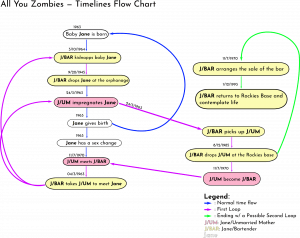
1. On September 20, 1945, the Bartender drops off baby Jane at an orphanage. She grows up there. She dreams of joining one of the “comfort organizations” dedicated to providing R&R for spacemen.
2. Nearly 18 years later, the man who refers to himself as “an unmarried mother” is dropped off at April 3, 1963, by the Bartender. He meets and, after some weeks of dating, seduces and impregnates the 17-year-old Jane, who has an intersex condition. From Jane’s point of view, he then disappears. Actually, he has been retrieved by the Bartender, and taken to 1985 (see sixth bullet point).
3. Jane learns that she is pregnant by the now-missing unknown man. After giving birth by C-section, she is found to be a “true hermaphrodite” who has been severely damaged by the pregnancy and birth; on waking she learns that she has been subjected (without her consent) to a “sex change” which reassigns her sex to male.
4. On March 10, 1964, the Bartender kidnaps the baby and takes it back in time to the orphanage (see first bullet point). Jane, now male, becomes a stenographer, and then a writer. Whenever he is asked his occupation, he replies, somewhat truculently, “I’m an unmarried mother—at four cents a word. I write confession stories.” He becomes a regular at the bar where the narrator, the Bartender, works, but does not interact with him significantly for six years.
5. On November 7, 1970, the Bartender meets the Unmarried Mother, yells at the customer playing “I’m My Own Grandpa“, conducts the Unmarried Mother into the back office, and takes him back to 1963 to “find” (and, ostensibly, get revenge upon) the man who got him pregnant (see second bullet point). He returns to the bar, seconds after going into the back room, and allows the customer to play the song. From his own point of view, he has carried out his mission of ensuring his own existence.
6. On August 12, 1985, the Bartender travels to 1963 and retrieves the Unmarried Mother — whom he had left there (then?) during the events of the fifth (and second) bullet point(s) — to the Rockies base and enlists him (actually a younger version of himself) in the Temporal Bureau.
7. On January 12, 1993, the Bartender, who is also Jane/mother/father/Unmarried Mother, arrives back at his base from 1970 to think about his life.
November 17th & 18th, 2025
So by now, I’m sure you’re aware that if one changes even the slightest thing in the past, then the consequences could be dire.
This next story is one that is similar in theory, but has a few differences. Basically, it’s about a jealous ex-boyfriend trying to mess up a happy marriage by trying to erase the married couple’s past. Pretty cool idea.
Please work on these questions for tomorrow:
- How is the realism portrayed in this story, taking into account the fact that it is a conceptual fantasy piece?
- What are the elements that make Needle in a Timestack a fantasy story rather than a Sci Fi story?
- Why would having the capability to time travel in today’s society be a problem?
- What are the different motivational qualities of the main characters in A Needle in a Timestack and how are these qualities both an asset and a detriment?
- Does the story align with the beliefs of our contemporary Western society in regards to romantic love and the idea of soulmates (or that two people are ‘fated’ to be together)?
- What made this story’s version of cause and effect so interesting to the reader?
- How are the basic emotions of the human condition portrayed through the actions of the characters?
BONUS:
Also take into account a reader response. You DON’T have to do this without me but look at the questions.
- Do you like or dislike the text?
- Do you agree or disagree with the writer?
- Does the text clash with your personal views?
- How does the text relate to you personally?
- To what extent did the text challenge or change your opinions or beliefs?
- Did you learn anything from the text? If so, what did you learn?
- What is your overall reaction to the text?
For a response, you are to look back at the answers you have just written from these general ones and come up with a claim (thesis) summarizing everything you’ve written.
Example: You wrote about how both Mikkelsen and Janine are both fighting to keep their love in tact. So you can summarize with “Love is seen of as fleeting, yet something worth fighting for in Silverberg’s “Needle in a Timestack.”
November 13th, 2025
Let’s do Musical Fridays this week. I’ve been sick all week and I’m behind on most things including our Musical Mondays. It’ll all be back to normal again by next Monday.
I’ve decided to jump straight into the Time Travel Unit and today will be our introduction.
We will do spoken word after – I still need the Riverside appropriate documents.
Here is a run down of what we will be doing –
V3.5_21_Time Travel Short Fiction Introduction
Discussion Questions: (Write, then discuss with a partner)
- What is the definition of Science Fiction?
- What are some examples of science fiction stories? (Movies, Manga, Fiction etc.)
- Is science fiction an effective genre? Why or why not?
- What sub-genres of science fiction can you think of?
The short stories I have chosen for this specific unit are ordered and as follows:
A Sound of Thunder
[We will do a pre / during / post reading of this text in a worksheet. Here is the story:
Here is the worksheet. It is due Friday at midnight.
Next:
Needle in a Timestack
All You Zombies
Yesterday was Monday
Red Letter Day
And if we have time: This is one of the academic skills I want you to take away:
November 12th, 2025
Finish the independent novel study today. We’ll start a new unit tomorrow.
DUE today: PODCAST – upload to teams with your names.
Here are some specified podcast questions:
Independent book questions podcast V3
November 10th, 2025
Continue your independent novel study.
And here is the rubric:
Novel-Study-Project-Rubric-2018
DUE WEDNESDAY: PODCAST:
Here are some specified podcast questions:
Independent book questions podcast V3
November 7th, 2025
Independent Novel Study Day:
FINAL JOURNAL ENTRY:
Journal 3: Completion
- Was the ending satisfying or disappointing? Why?
- What big takeaway or message do you leave with?
- Which final project idea best shows your deeper understanding of this book?
- Would you continue with this author or genre? Why or why not?
INDEPENDENT READING PROJECT INFORMATION:
Information on Independent Novel Project:
What is the independent Novel Study Project?
Here is the project (Old Version)
Independent Project Final_2021
Here is the NEW VERSION:
And here is the rubric:
Novel-Study-Project-Rubric-2018
DUE WEDNESDAY: PODCAST:
Here are some specified podcast questions:
Independent book questions podcast V3
Record yourselves talking about this. We will get everything clear before you start.
November 5th, 2025
Outline (Physical & Online) BTTFOutlineV2
Please complete this today as the test will be TOMORROW (Thursday).
Missing class? Let me know.
November 4th, 2025
Plan for completion of this unit –
You have all of the data now. It is time for us to put all of your newfound knowledge to work and finalize this film terminology unit once and for all.
- Lost scene – Due today Per. 2 / Per. 4 Here is the handout: Lost Scene and Final Essay
- Final essay outline. You have until THURSDAY to complete this. (Physical copies as well) BTTFOutlineV2 . Thursday will be the in class writing. I will be doing one on one tutor sessions tomorrow during class. If you’re noisy, you can leave.
Friday: Independent novel study unit will complete (By the following Wednesday after Memorial Day.)
Next Thursday: (November 13th) We will do the spoken word unit.
November 3rd, 2025
Musical Mondays:
Per. 2
- Kai
- Breanna & Zoe
- Mary & Sama
- Karan & Arish
PART 2:
Here is the sheet for the last part of the film terminology unit. The first part is the “Lost Scene” where you storyboard a scene left on the editing cutting room floor. This is a creative assignment.
I will have printouts of this as well:
October 31st, 2025
We will end the movie. Day 4- Editing and Movement.
Remember your “Expert” group. I will write it all out on the board so that you will remember.
ALSO
Today, I’d like for you to create a pitch for a “Lost scene.” This means, writing an idea for the movie as a fanfiction that you can storyboard. This is difficult, as there needs to be continuity to the scene. NO first or last scene. It has to go INSIDE the film somewhere. I’ll give examples.
October 29th, 2025
We will continue with the movie. Day 2: Lighting
Remember your “Expert” group. I will write it all out on the board so that you will remember.
If you wanted to do an online version, here’s the film package – otherwise give me the final package on Friday after everything has been completed.
October 28th, 2025
We will continue with the movie (or start in period 2)
Remember your “Expert” group. I will write it all out on the board so that you will remember.
If you wanted to do an online version, here’s the film package – otherwise give me the final package on Friday after everything has been completed.
October 27th, 2025
Musical Mondays today.
PERIOD 2
- Sofiia & Paula
- Nathalia & Jaqueline
- San
PERIOD 4
- Claire & Prinsca
I would also like to remind you that the books should be finished this week as the independent novel study finals will be next week.
I have decided that those who are keeping good journals will be rewarded, but I have lowered the amount of journal entries to 3. These are the final questions. You can work on them today if we have time after the Musical Mondays presentations.
Journal 3-5: Completion
- Was the ending satisfying or disappointing? Why?
- What big takeaway or message do you leave with?
- Which final project idea best shows your deeper understanding of this book?
- Would you continue with this author or genre? Why or why not?
Period 4 – since there’s only one Musical Mondays, we will begin the film today. Period 2 will make up the time some other way.
October 22nd, 2025
Film unit terminology projects continued – We will present today. If we have time:
STORYBOARD EXERCISE:
You will continue this tomorrow when I’m not here. The project is due on Monday. I’ll try and explain before we go today.
Storyboard_Practice_Worksheet_Grade10
October 21st, 2025
FILM UNIT CONTINUED:
The rest of the video:
Your exercise will be to find a clip from your favorite movie and show me some of these vocabulary words explained. I will provide examples before you start.
October 20th, 2025
Musical Mondays Prep:
Musical Mondays Final Presentation Guide
Now that you’ve seen six different styles of how musical genres and themes can be connected, it’s your turn to come up with a final presentation and paper that is a culmination of all the connective tissue of writing and presenting in class. I will list them for you.
So why do we do Musical Mondays? So that you can understand:
- Literary Lenses
- Literary Analysis
- Musical / Poetry Analysis
- Creativity
- Reader Response Evaluation
Today is the first day of your preparation for the final. Here are some things you need to do so that when you write your paper, you will have all of the necessary evidence and prerequisites.
There are two parts to the final. You will be graded as an individual, but can perform in groups.
Part 1 – Paper guidelines (Do this first):
Critical response multi-paragraphs do not simply summarize the text or evaluate whether you like the text; they are a three paragraphs, persuasive, and focused analysis, argument, or interpretation about the text. They not only help you think critically about the texts you read but also help you formulate ideas that can be expanded into longer essays. There are four parts to a critical response multi-paragraph:
You will be doing your own analysis / question and answer on lyrics or musical elements. I would like to see the outline (which are the questions I’ve been making you do for seven weeks) and a final paper that is well polished with a thesis and topic sentences with evidence from the songs themselves.
1) an argumentative topic sentence (What is the connecting theme??)
2) evidence in the form of quotations or paraphrases for the argument you are making, (Lyrics that fit your theme)
3) interpretation of your evidence in relation to the argument (Analysis of the theme and lyrical interpretation)
4) Personal connection (How does this song connect to you?)
4) a strong concluding statement.
Note: This is a review and collaboration of your lens paragraphs and non fiction narrative writing– an extended idea that is fully developed and flows well.
Part 2: Presentation guidelines (DO this as a ‘fake rough draft’ today.)
Follow these directions in a PPT / Canva / Whatever Presentation:
Before you play the song – discuss this / present this to the audience:
- What is/are your song(s)?
- What themes can you connect your song to? What bigger idea about society?
- Explain the lyrics of the song in detail.
- Play the song
- Have questions / activity for the class to do either group or individual.
- Discuss
- Provide everyone with a final ‘takeaway statement’ to end the lecture.
FILM UNIT CONTINUED:
Your exercise will be to find a clip from your favorite movie and show me some of these vocabulary words explained.
Here is an example:
October 17th, 2025
Reading.
NEW UNIT DAY.
Film as Literature.
Here’s a plan:
Understand film as literature / Understand film techniques and vocabulary.
The unit itself is also a chance for you to review analytical paragraphs and enjoy movies on a deeper level.
Lesson 1:
Film Terminology:
We will go over shots. Here is a video we will watch:
Your exercise will be to find a clip from your favorite movie and show me some of these vocabulary words explained.
Here is an example:
October 15 & 16th, 2025
These two days will be a quiet working environment for preparation of the final Archetypes essay.
Here is the outline again. Follow the structure and you’ll be fine.
- finish the introduction.
- Check with me.
- Finish the outline (following the prompts)
- Final check with me.
- Write the first draft, expanding your ideas and using conjunctions and transition fluency.
Then you’ll be ready!
October 14th, 2025
Reading / Journals.
Crossover Genres (or ‘Polystylism’): Getting out of your Comfort Zone
This unit is a two in one, as I had two similar ideas that seem to blend well together – this is actually apt as the whole presentation is about how music went to crossover genres as a marketing gig in the 90’s – yet it’s always been there, we just called it different names in the past. ‘Experimental’ ‘era-bending’ etc. the list goes on.
I’m focusing on how crossover genres got me out of my purist ‘rock’ ‘rap’ mindset when I was young. So another way to look at this unit is how to listen to music that you don’t usually listen to. For me, that was when I was introduced to crossover genres. Nowadays they’re more common than Subway sandwich franchises.
Here are some of the… I wouldn’t say best, but the most well known. I picked three out of the usual 10+ on my shortlist.
Maybe the most iconic cross-genre performance known to popular culture. The best part perhaps is that Run-D.M.C. doesn’t even bother to change the lyrics, suggesting that Steven Tyler was a rapper without even knowing it.
This one I don’t even know that well – just a strange combination that works. RIP Juice WRLD. Long live BTS
Well this one is strange, but I’m on a Post Malone kick now and thought it would fit the lecture. I’m not sure if these two should ever collaborate again, but I like this song sparingly. Marketing or creative choice?
Assignment:
Since this is a double lesson combined, there are four questions. I expect a lot now that you’ve done this five times before. I think this might be my last music lesson, because you should be ready – next week will be all about you putting everything together for when it’s your turn to present.
- What do you think the reason is for crossover genres? Do you think that it’s a money making scheme or a creative liberty to expand our musical horizons? Explain this answer, because I would love to know the reason myself.
- Choose a crossover song that you can really get into – tell me your honest opinion of the song and why you chose it. The more obscure, the better. Give me a link to the song.
- What is a genre of song that you’re not comfortable listening to? Why do you dislike this genre? Are there any songs in this genre that you could get into, despite hating it generally?
- Choose a song from a genre that you’re not comfortable with or do not like. Give me a link to it. Analyze the lyrics. Tell me your experience now while listening to this song in a different lens than before. Try and choose a song you (kind of) like, rather than one you hate.
PART 2:
Have at least the introduction done. Depending on today, we will have another day to work on this paper before the in class write, or just get it done tomorrow.
FINAL OUTLINE:
October 10th, 2025
Journals 2–4: Mid-Read Reflections
- Focus on a character arc—how are they changing?
- What archetypes or patterns do you notice (hero, mentor, trickster, etc.)?
- What passages stood out? What hidden meanings or subtext did you catch?
- Track your emotions: when did you feel most invested or detached?
FINAL OUTLINE:
This is what we’re going to work on today. I would like everyone to have a “Claim” for the end of class and proactively be working on their outlines. Ask questions!!
For fun: Star Wars First draft:
For Quotes:
7 – Revised Fourth Draft – March 15 1976 (with April 19 revisons)
Model Example:
Star Wars Archetype Analysis
“A very typical example of a certain person or thing,” reads the dictionary definition of an archetype, however, this may vary depending on your archetype perspective. Similar to a stereotype, archetypes categorize characters by their behaviors and feelings, almost like a genre for people. In film, literature, music, and reality, archetypes go beyond characterization diving into scenarios, symbolism, and plot. Malcolm Gladwell’s David and Goliath provides the outlook of the underdog archetype in society. “I wasn’t born this way, this was forced upon me” Reads the opening of the seventh chapter, highlighting the disadvantage felt by those in an underdog position. Despite whatever actions they may take, the underdog feels challenged by their surrounding environment. However, this does not stop them from striving for better circumstances and working with their challenges to achieve greatness. The use of archetypes gives media structure and variety. They create depth while capturing what is the phenomenon of being human. The focus on the underdog creates relatability and reminds viewers of themselves in one way or another. The underdog typically carries enjoyable characteristics such as determination and optimism, they are a character people like to live through. Another example is the George Lucas film, Star Wars, A New Hope. The film takes on salvation, collaboration, and conflict while following Luke Skywalker, the underdog, who embarks on his journey through life. Viewers watch as Luke experiences change and growth while struggling through the trials of an underdog. More so, the film explores a variety of character, scenario, and symbolic archetypes, demonstrating how they interact with each other and situations. The archetypical representation allows room for connection, creating a lasting impact from an action film like Star Wars.
When further analyzing the George Lucas film example, Star Wars, archetype significance in storytelling is evident. The film takes on a variety of apparent archetypes between each character, situation, and overall plot. This creates the opportunity for the audience to identify with the story while adding layers of dimension. The characters are presented in a way that makes their role in the story clear. For example, “Loyal Retainers,” C3PO and R2D2 are introduced in tension, but the two focus on other characters and lack logic. This demonstrates the loyal, yet senseless characteristics shown by C3P0 and R2D2 throughout the film. The same idea applies for the rest of the characters such as “The Damsel in Distress,” Princess Leia who showed her distress but aspiration. The distinctive character archetypes demonstrated throughout the film allow for structure and familiarity and enhance viewer to character connections. Additionally, Star Wars follows the situational archetype “The Journey.” Throughout the film’s progression, the plot hits the archetypical markers such as beginning of adventure, character growth, rock bottoms, and salvation. This once again creates familiarity for viewers, creating an enjoyable viewing experience. All in all, the incorporation of archetypes in Star Wars guarantees a successful production. People love what they know, and the variety of characters and situations means there is something for everyone.
Although Star Wars contains an array of character stories, personalities, and developments, there is an undoubted focus on Luke Skywalker. Viewers watch as the protagonist Luke goes on his own journey of change both physically and mentally. Unlike other characters of the film, Luke experiences something new he does not know, making him “The Underdog.” From his small planet of Tatooine, to the galaxy of endless possibility, Luke undergoes the changes of a lifetime. He is exposed to an entirely new world, and this does not come without challenge. Despite strong support, Luke struggles through learning the ways of this new life and faces a countless amount of adversity. In the end, Luke overcomes the difficulties he faced through persistence and resourcefulness. This plot line directly plays into the situational archetype of “The Journey” and the character archetype “The Underdog.” The role of the underdog is crucial to any story as it is a role viewers can easily connect with. Whilst Lukes story may not be one that is directly relatable, it is easy to understand the struggles that were encountered. Luke felt discouraged in himself at various points throughout the story but stayed strong and eventually found success. This story in itself is not only one viewers have likely experienced on their own, but one that is a pleasant watch filled with tension and relief. The emphasis on Luke Skywalker and his underdog story lets the audience identify with the film and adds an emotional aspect to the movie.
In conclusion, archetypes are how society can classify the behaviors and feelings of one another. They provide familiarity which is a crucial part of our existence. Archetypes in film are an important piece to the structure of a story and deepen the emotions and connections of the audience. In the film Star Wars, A New Hope, archetypes, specifically the underdog archetype set the theme for the film and create a strong outline. The highlight of the underdog brings realism and interaction to a plot that may not be realistic, in turn enhancing viewing experiences. “Fundamental to our analysis is the assumption that the population, as individuals or groups, behaves ‘rationally.’.” Reads chapter seven of Malcolm Gladwell’s David and Goliath, reassuring the idea that everything plays into an archetype in one way or another. Altogether, film, literature, and even reality stand on the basis of archetypes and they are key contributors to our society.
October 8th, 2025
Reading / Journals (PER 4)
We will finish the movie today, then you will have an outline to prepare you for the final paper in class write. Everything we’ve been doing for the whole unit comes down to this! We will talk briefly about the questions you’ve finished.
You’ll be fine!
FINAL OUTLINE:
FINAL OUTLINE:
For fun: Star Wars First draft:
For Quotes:
7 – Revised Fourth Draft – March 15 1976 (with April 19 revisons)
October 7th, 2025
WOTB_Intro_and_Archetypes_2020
FIRST: You need to do this worksheet – I’ll have paper copies as well so that we can have a discussion once the film is over.
StarWarsANewHope_Discussion-questions V2.5
Please no talking during the movie – I’ll ask you to leave if you do. Also, no phones. Why would you need them?
October 6th, 2025
MUSICAL MONDAYS #5:
Protest Songs
Every generation has an anthem or song that defines them. Music, as we’ve found out, is subjective and personal. Yet there are some songs, factoring in where those songs were played, (For example – an American wouldn’t think that the Korean song “Come Back Home” by Seotaiji would define their American cultural experience in the 1990’s) contribute very heavily to the generation it was played.
Nina Simone – Mississippi Goddamn (1965)
- God Save the Queen – Sex Pistols 1976
3. Bulls on Parade – Rage Against the Machine 1996
- Fight the Power – Public Enemy – 1989
- In Bloom – Nirvana 1991
These songs are not the definitive voice of a 35-year period, but their lyrics were cutting edge; the songs themselves were completely new and fresh, daring and authentic.
Your job is to look for a connection between self and society. What is the song of your generation? Go through these questions for the criteria to be met:
- Describe your generation in five descriptive words (Adjectives).
- What is the music that you and your peers are into (if anything?) Who are your heroes? What is ‘popular’ now currently? How has that changed from your past? As a contrast, what is uncool? Be as specific as possible.
- Focus on other areas of popular media that have to do with your generation. What are they? Why are they important to you and your friends?
- Create a slogan (phrase that is marketable) for your generation.
A. Example: We don’t care about your rules! Freedom unites us all!
- Choose a song that is an emblem (guidepost) for your generation OR goes with the slogan you’ve just created. Tell me about the song a little bit.
WE WILL FINISH THE PRESENTATIONS IN THE LAST 20 MINUTES OF CLASS.
October 3rd, 2025
Reading 10 mins
Start thinking about the second journal entry.
Journals 2–4: Mid-Read Reflections
- Focus on a character arc—how are they changing?
- What archetypes or patterns do you notice (hero, mentor, trickster, etc.)?
- What passages stood out? What hidden meanings or subtext did you catch?
- Track your emotions: when did you feel most invested or detached?
Presentations today. We will go from Chapter 1 – Chapter 9.
If we have time, I’ll prep you for Tuesday’s class:
I have organized the archetypes in the movie to this PPT:
WOTB_Intro_and_Archetypes_2020
FIRST: You need to do this worksheet – I’ll have paper copies as well so that we can have a discussion once the film is over.
StarWarsANewHope_Discussion-questions V2.5
Please no talking during the movie – I’ll ask you to leave if you do. Also, no phones. Why would you need them?
October 2nd, 2025
Reading 10 mins.
Please finish the presentations with your groups. If we have time, we can start today.
Here is the list again:
- Chapter One – Basketball : Michaela Hassan Roy / Valentin Karan Isaac
- Chapter Two – Class sizes: Basheer & Jacob / Taylor, Cecily
- Chapter Three – Selecting a university: Natalia Julia, Berta, Gabriele / Conrad, Andrew
- Chapter Four – Dyslexia; Rhys Coral / Max Tyler Liam
- Chapter Five – Childhood trauma: Breanna & Zoe, Grace / Maddie Claire Prinsca
- Chapter Six – The Civil Rights Movement : Azim, Chun-Hei/ Jesse, Mohammed
- Chapter Seven – Authority figures: Kai / Arish Yousuf
- Chapter Eight – Crime and punishment: Paula & Sama & Nika / Raquel Alissa Niko Maelle
- Chapter Nine – Nazis and the French resistance: Matias, Josh & Maxwell / Morris, Owen, Haiven
PRESENTATION PREPARATION:
Summarize the piece. Then answer the following:
- Who and/or what are the Davids?
- Why are those David more powerful than others presume?
- Who are the Goliaths?
- Why are those Goliath not as powerful as they seem?
And give evidence:
| QUOTATION | SIGNIFICANCE |
| 1. | |
| 2. | |
| 3. |
October 1st, 2025
Reading – 10 mins
Read the introduction only.
David and Goliath – Malcolm Gladwell
After reading the Introduction as a class, you should be able to answer the following questions that we will discuss formally:
1.What does Gladwell mean by “giants”?
2. In what ways was David an underdog?
A. In the Bible, what is the original story of David and Goliath?
B. What is the moral we usually take away from this story?
C. What is Gladwell’s new explanation of David and Goliath based on modern theory?
You are now going to be put into groups of 3. Each will tackle (Individually) the chapter. Prepare a presentation using the questions below.
- Chapter One – Basketball : Michaela Hassan Roy / Valentin Karan Isaac
- Chapter Two – Class sizes: Basheer & Jacob / Taylor, Cecily
- Chapter Three – Selecting a university: Natalia Julia, Berta, Gabriele / Conrad, Andrew
- Chapter Four – Dyslexia; Rhys Coral / Max Tyler Liam
- Chapter Five – Childhood trauma: Breanna & Zoe, Grace / Maddie Claire Prinsca
- Chapter Six – The Civil Rights Movement : Azim, Chun-Hei/ Jesse, Mohammed
- Chapter Seven – Authority figures: Kai / Arish Yousuf
- Chapter Eight – Crime and punishment: Paula & Sama & Nika / Raquel Alissa Niko Maelle
- Chapter Nine – Nazis and the French resistance: Matias, Josh & Maxwell / Morris, Owen, Haiven
PRESENTATION PREPARATION:
- Who and/or what are the Davids?
- Why are those David more powerful than others presume?
- Who are the Goliaths?
- Why are those Goliath not as powerful as they seem?
And give evidence:
| QUOTATION | SIGNIFICANCE |
| 1. | |
| 2. | |
| 3. |
The presentation should be 5 minutes (give or take). As a group, this should be easy. Minor letter grade.
September 29th, 2025
Reading!
Musical Mondays #4
Soundtracks and Scores of each Individual
So when we put a visual to our auditory experience, it connects on a deeper level – even if you don’t like music, we can all agree that there is a lot to be said about the emotional impact of a movie or story we watch and the soundtrack to go with it. Unless it’s a Coen Brother’s film (No Country for Old Men), most movies have a soundtrack – either made specifically for the movie (like a score to enhance the mood or feel) or pre chosen songs in different context to their original intended audience (Like Quentin Tarantino films).
I have chosen 4 movies where the soundtrack has changed, not only my musical preferences, but also my connection to the film itself / the strengthening of my neural connections to the film, the impact and the flashbulb memory to where I personally was in this space of time. Before I get there –
I like this quote:
“When I listen to my movie scores, I play songs that I know will make me feel a sort of way. I sometimes walk a little faster to class if I listen to the score from an intense battle scene, or I find myself more mellow and slow-moving when listening to a soft love theme. When I need to get motivated for an exam or to complete household chores, I go to specific songs, and when I need to cool down and relax, I go to different tracks. The beauty of all music is that it persuades you to feel a certain way—movie scores included.”
These are the songs / scores to the movies I have a personal connection to:
Vanilla Sky is a great movie, but also connected me emotionally to a band called Sigur Ros – an amazing ‘post rock’ band that I still am listening to 20 years later.
What a great ending to a great movie. This is The Pixies – Where is My Mind – whenever I listen to this song, I think of this movie.
I have to put Quentin Tarantino in this because a lot of his songs I’ve loved and have been given a huge genre of music to open up to – the thing is, a lot of these scenes I like are not school appropriate – but this one is – and it has Isaac Hayes ‘Tough Guys’ theme to a cool Kung-Fu scene. Tarantino did this a lot.
Probably my favorite ending of all time – Just Like Honey by The Jesus and Mary Chain was a great addition – indie rock surged again after this movie came out. My Bloody Valentine was also introduced to a new generation. I also love this movie as it is very personal to me – as it is to a lot of people who saw it when it came out.
Your task:
Now that I look at these selections I’ve made, I think that there is a common theme here, but it’s up to you to decide what that is.
Here is your task:
- How does the connection between sound and visual enhance our connection to a work of art? Can you think of examples?
- Is there a time in your life – an interesting experience you’ve had – that could have used a great song to make the experience even better? Explain the memory and explain the song you chose to the memory.
- Choose a song that you loved from a particular movie / animation / TV show etc. Give me a link to the song or the clip of the movie where the song is featured. Explain why you chose this song & this movie clip. Where were you in this space of time?
If you’re finished, read the introduction to this:
David and Goliath – Malcolm Gladwell
September 26th, 2025
Reading / Tentative – journal #1 is due today:
Journal 1: Starting Out (about 50 pages in)
- Do you want to keep reading this book? Why or why not?
- What drew you to this book initially?
- First impressions: characters, plot, or writing style.
- Connections to other books, films, or personal experiences.
TODAY:
Finish the presentations.
IF WE HAVE TIME:
Read the introduction only.
David and Goliath – Malcolm Gladwell
After reading the Introduction as a class, you should be able to answer the following questions that we will discuss formally:
- What does Gladwell mean by “giants”?
- In what ways was David an underdog?
- In the Bible, what is the original story of David and Goliath?
- What is the moral we usually take away from this story?
- What is Gladwell’s new explanation of David and Goliath based on modern theory?
You are now going to be put into groups of 3. Each will tackle (Individually) the chapter. You will be doing what is called a (partial) annotated bibliography on it tomorrow.
- Chapter One – Basketball :
- Chapter Two – Class sizes:
- Chapter Three – Selecting a university:
- Chapter Four – Dyslexia;
- Chapter Five – Childhood trauma:
- Chapter Six – The Civil Rights Movement :
- Chapter Seven – Authority figures:
- Chapter Eight – Crime and punishment:
- Chapter Nine – Nazis and the French resistance:
September 25th, 2025
Reading (Final trial day) – journal #1:
Journal 1: Starting Out (about 50 pages in)
- Do you want to keep reading this book? Why or why not?
- What drew you to this book initially?
- First impressions: characters, plot, or writing style.
- Connections to other books, films, or personal experiences.
I think that this is a shortened day – so we will spend it working on your presentations.
- Finish the presentations.
- Volunteers for showing presentations. (Instant higher grade)
September 24th, 2025
Reading 15 mins then activity day:
Task 1: Self Evaluation “My Archetype”
Take the Myer’s Briggs style test. Tell me what your archetype is – what this means to you and whether it is an accurate categorization of who you are as an individual. It is argued that all humans fall into 16 categories.
https://www.16personalities.com/free-personality-test
Task 2: Characterization
You are to find a clip from a movie, TV show or animation and show me the different character archetypes you find. Use the archetype PDF as an example and use the vocabulary that describes the archetype. The PDF is below:
 Loading...

 Reload document
  Open in new tab
 EXAMPLE:
Archetypes Shown in “Frozen” (1)
September 23rd, 2025
New unit is Archetypes
Here is an overview of the entire thing:
Underdogs-Archetypes-Introductionv2.5SW
Now let me explain what these questions connect to with a very visually unappealing PPT – take notes as this will be revisited many times throughout the unit:
Archetypes Notes for Outline 1
Task 1: Self Evaluation “My Archetype”
Take the Myer’s Briggs style test. Tell me what your archetype is – what this means to you and whether it is an accurate categorization of who you are as an individual. It is argued that all humans fall into 16 categories.
https://www.16personalities.com/free-personality-test
Task 2: Characterization
You are to find a clip from a movie, TV show or animation and show me the different character archetypes you find. Use the archetype PDF as an example and use the vocabulary that describes the archetype. The PDF is below:
Loading...
September 22nd, 2025
Reading.
Musical Mondays #3
Songs in Translation
Music, of course, transcends verbal language. I believe that there is a lot to be said about music around the world. This is not to be confused with World Music – that’s another genre. What I’m talking about is that sound crosses all borders and makes an ignition – the key turns for a new sound and then it blows up around the world. It’s a phenomenon. Think about all the subgenres we have in our own language and then refer to all music from another country as a huge category. Not all music from Korea is Kpop – not all music from Sweden is Black Metal. (Etc.) A lot of my friends from other countries who had never been to Canada thought most Canadian music was French folk songs and Rush.
I will introduce four songs 3 Korean, one Japanese – out of thousands I’ve really enjoyed and then ask some specific questions before you go on a hunt. I’m mostly into songs from Eastern Asia, but you can choose songs from anywhere in the world.
Seotaiji –
This artist is so influential in his native South Korea that it is often said music can be divided into two eras: pre-Taiji and post-Taiji. He is often referred to as “the President of Culture”. He can sing, dance, play guitar, bass, produce, he’s a fashion icon, a businessman and a composer.
The Brilliant Green (Japan)
The Brilliant Green take much of their influence from Western music, most predominantly the Beatles with over half their songs including English lyrics. They released their first single “Bye Bye Mr.Mug” in 1997 with little success, but their break came in 1998 when their third single “There Will Be Love There” was chosen as the theme song for popular the Japanese drama Love Again, and as a result went straight to the top of the charts. This is my favorite:
Drunken Tiger (Back to Korea)
Drunken Tiger (Korean: 드렁큰 타이거) was a Korean hip hop group that debuted in 1999 and has since released several albums and won numerous awards. They are known as pioneers of Korean hip-hop who helped bring the genre into the mainstream. This is of his more Recent EP – The Cure.
I have a shout out to some great Icelandic bands but I’ll spare you.
Here’s my favorite now. Perhaps some of you know it?
Best line:
“나의 작은 마음도 그 안에 작은 파도처럼 부서지고 밀려와선 네게 녹아내리고 그제서야 보이는 나의 영원”
“My small heart, too, breaks and surges like a tiny wave, melting into you, and only then does my eternity become visible.”
Your task:
This is a little difficult, as a lot of you might not know songs from other countries – or maybe you do. Every class is different. What I want you to do is find a song from another country and is not in English. You can choose an English song that’s been translated into another language if you’d like.
Questions I’d like for you to put into a coherent paragraph with a link to the song and the lyrics:
- What is the difference between listening to a song for the beat and for the lyrics? What kind of music listener are you?
- How is listening to other cultures / country’s songs beneficial to you? What can we learn from music and the countries they come from?
- Find the lyrics to your song (Both English and the original language) after you listen to it once. Now you might know the language – if you do, does the English translation change the meaning? If you do not, then how does understanding the lyrics to the song make it different? Does the experience change for you?
September 18th, 2025
Today is the in class writing. All you can have are the following:
- Pencil / Pen
- Eraser
- Your notes for the essay
- teacher provided paper
September 17th, 2025
Reading your books: first day. Keep in mind your first journal entry due next Friday.
Journal 1: Starting Out (about 50 pages in)
- Do you want to keep reading this book? Why or why not?
- What drew you to this book initially?
- First impressions: characters, plot, or writing style.
- Connections to other books, films, or personal experiences.
TASK:
Please use this time to prepare for your in class essay tomorrow.
September 16th, 2025
PART 1:
Today, we will go to the library to learn about the Independent Novel Study Project.
We’ll talk books.
This is everything you need to know about the project in detail:
PART 2:
Finish those Aladdin outlines. The in class essay is this Wednesday, September 17th. All you’ll have is a pencil, your outlines and paper. Get as ready as possible!!!
September 15th, 2025
MUSICAL MONDAYS #2
Alternative rock came about in the 90’s. Some of you might have heard about it , some not. I am giving you three songs that had their moment in the sun, then passed away. These are one hit wonders – in my own time growing up. We love songs then hate them after some time has passed. These songs were some of those songs for my generation.
A one-hit wonder is a song that makes a huge impact. It charts high, goes viral, gets radio play, or becomes part of the cultural conversation, but the artist never reaches that same level of success again.
They may release more music, but nothing else sticks the way that one hit did.
SO one hit wonders are:
-
Catchy party anthems (“Jump Around” – House of Pain)
-
Unexpected ballads (“Bittersweet Symphony” – The Verve)
-
Songs tied to a cultural moment (e.g. viral trends, movie soundtracks, TikTok sounds)
They aren’t always bad — in fact, they’re often brilliant. But they burn out fast.
Questions:
-
Why do some songs lose their magic over time?
-
What does “over-saturation” really mean — and how does it change our experience of music?
-
Why do some songs make a comeback years later?
-
What part of a song stays with you: lyrics, beat, or memory?
-
Can a “one-hit wonder” still matter in music history?
Activity:
Step 1: Define it in your own words.
In a sentence or two, how do you define a one-hit wonder?
Step 2: Choose a song you believe is a one-hit wonder.
It could be from your childhood, a TikTok era, a party playlist — anything you feel fits.
Step 3: Justify your choice. Answer these in a paragraph:
- Why do you think this artist only had one big hit?
- Did the song feel overplayed or iconic — or both?
- Does anyone still listen to this song now?
Examples:
- Jump Around – House of Pain
2. Chumbawumba – I get Knocked Down
https://www.youtube.com/watch?v=2H5uWRjFsGc
3. Whetus, Teenage Dirtbag:
September 12th, 2025
Structure for essay:
Literary-3-Paragraph-Specific-Outline_RU
Through what lens best represents the meaning of Aladdin? Provide evidence to support your answer in a 500-750 words multi paragraph response.
Focus on those three questions again to help you with the body paragraph.
- What lens best represents the movie and why?
- What three pieces of evidence can you find (in the transcript or your notes) that backs up this lens?
- What does this mean as a ‘bigger picture’? For example – what can we take away and learn from this episode?
Transcript of Movie:
https://movies.fandom.com/wiki/Aladdin_(1992)/Transcript
Peer review:
Peer Review 3PP Essay Structure
September 11th, 2025
We will watch Aladdin today and then you can start on the outline.
Here is the outline again: Literary-3-Paragraph-Specific-Outline_RU (I will have paper copies as well)
September 10th, 2025
I will give you some time to finish and submit these paragraphs to me.
If you are not working well, or if everyone is finished, we will work on the final section of this unit:
We will start Aladdin today and talk about the lenses. You will have time to formulate an outline today and tomorrow. Keep it as you will be handing it in with the final.
Introduction-to-Literary-Theory-Grid-Grade-10.11Download
Focus on those three questions again (from the Simpsons episode) to help you:
- What lens best represents the movie and why?
- What two pieces of evidence can you find (in the transcript or your notes) that backs up this lens?
- What does this mean as a ‘bigger picture’? For example – what can we take away and learn from this episode?
Structure for essay:
Literary-3-Paragraph-Specific-Outline_RU
This will help you if you need help. We’ll go over it after the movie is over:
Marxist:
- Why is the poorest character—Aladdin—the only one who’s able to enter the Cave of Wonders?
- How are Jasmine’s choices limited because of her status as a woman?
- Why do you think Aladdin sees wealth, riches, and increased social status as a way of winning Jasmine’s heart? What does he learn about her as he tries to woo her this way?
Psychoanalytical:
- Toward the beginning of the movie, Jasmine releases her birds from their cage. Can you think of any other symbols of freedom or confinement in Aladdin?
- What do you imagine the Genie’s life has been like? What’s his backstory? What will he do after being freed?
- Do you think the comparison between Aladdin and Jasmine is fair? Are both of them equally trapped by their circumstances? Does one of them have it worse? Why or why not?
Postcolonial:
- Why do you think Jafar really wants to be sultan?
- How does Aladdin react to finally having some power when he finds the Genie? How is his reaction different from Jafar’s?
- If the Sultan had the power to change the laws in Agrabah this whole time, why didn’t he change them earlier when he saw Jasmine was so unhappy?
September 9th, 2025
The Simpsons.
Here is the script of the show:
https://www.simpsonsarchive.com/episodes/3F05.html
I’ll upload the show to Teams as well.
And we will briefly look at a part of an undergraduate paper from someone who studied in the University of Iceland. Luckily, it was on The Simpsons and lenses… but how they look a little later down the academic road. We’ll discuss it:
EXCERPT:
2.1 The Pleasure Principle in “King-Size Homer”
In the seventh episode of the seventh season of The Simpsons, Homer strives to obey the pleasure principle to new extremes. In a mandatory five minute session of calisthenics at the Nuclear Power Plant, Homer finds out that one of his co-workers got injured on the job and is now on disability with full pay. Upon hearing the news, Homer immediately decides to get himself injured enough to become disabled so he can work from home. Unable to harm himself, he realizes that hyper obesity can qualify him as disabled. He consults Doctor Nick Riviera, who recommends “a slow steady gorging process combined with assal horizontology” and that Homer focuses “on the neglected food groups such as the whipped group, the congealed group and the chocotastic.” With help from Bart, Homer begins his mission of overeating himself into obesity. This is obviously not a good idea; however, Homer is regulated by the pleasure principle, which entails that when confronted with pain he finds the easiest way to relieve himself of it (Freud, Beyond 1).
The ego’s intervention is too feeble, too late. Utterly disconnected with reality, Homer exclaims that this is everything he ever wanted and now, he finally is a “big fat dynamo.” He now works from home and for Homer that is enough. Of course, his happiness based on a change of scenery lasts only a few hours and although he does not have to face the morning traffic, he does have to succumb to the boredom of sitting in front of a computer all day pressing Y for Yes, N for No and Tab for ordering the soft drink TAB. To be fair, his job as a Nuclear Safety Inspector never seemed to require as much attention while he worked at the plant itself. Now, he has to actively take decisions over and over again on serious matters like venting gas to prevent explosions. Even when confronted with this critical task, he fails to realize the impact of his deeds.
END OF EXCERPT
Let’s think about these three questions:
- What lens best represents the episode and why?
- What two pieces of evidence can you find (in the transcript or your notes) that backs up this lens?
- What does this mean as a ‘bigger picture’? For example – what can we take away and learn from this episode?
First, you can have a discussion with partners, and then begin to make a good idea of this in your writing. Make sure to answer the questions based on the lens you have chosen. I will hand out a paper that is a matrix of lenses so that it can help you. This will also be used for the full length film.
Introduction-to-Literary-Theory-Grid-Grade-10.11Download
Here is Sam’s Paragraph from last year:
I chose to look through the Marxist lens (rich vs. Poor/ruler vs. The people). Homer wants to take advantage of his workplace program for those with disabilities even though he is perfectly fine and not struggling. It’s brought up by Lisa that the program is for those who can’t come to work for actual reasons. Another way it fits into the Marxist ruler vs. the people or wealthy vs. poor. It is that Mr. Burns is forcing the employees to do 5 minutes of calisthenics that Homer doesn’t want to do but the company uses physical force to make him do it. Some evidence for this claim is in the beginning when 2 workers drag Homer to the workout session while he screams and begs for it not to happen. Another way this fits into the wealthy vs. Poor is how he causes a restaurant to go out of business and ruin a man’s ice cream truck which puts people out of jobs while he has enough money to buy loads and loads of food without a care in the world. He then has Mr. Burns pay for his weight loss surgery in the end after fixing the catastrophe that he started because he took advantage of the work-at-home privileges of his disability. He also buys out whole grocery stores and you know what that does? It makes those supplies more in demand which causes them to cost more for struggling people because Homer wanted to work from home. What we can take away from this episode is that we shouldn’t abuse the privileges we have, like homer abusing the work from home program. He used his wealth to buy out the food of Springfield causing business to go under only to abuse a system made for struggling people. He got to get off work because he was so greedy and got to reap the benefits of the chaos he caused.
September 8th, 2025
New Term Long Unit! (Only on Mondays… or Tuesdays)
MUSICAL MONDAYS
When you analyze a piece for perceptive reasons, then the basic questions asked are the ones that seem simple, but provide evidence for good discussion.
Narrative in Song. Musical Mondays #1
Every song has a story to tell. Yet some stories are better than others. The artist actually has a narrative in mind when they write the thing, so what we have as listeners is a fully fleshed out story, characters, rising action, climax, the lot. The following four songs have stories to tell. It’s your job to understand what the plot is. Then at the end of the analysis, you are to write your own lyric based on the prompt given.
Choose 1 of these, or choose your own.
Space oddity – David Bowie
Stan – Eminem (Clean Version)
This is America – Childish Gambino
Eleanor Rigby – Beatles
- Choose a song as a story. What is the story about? Give a summary of the story as you understand it.
- What is the effect of this story as a song? How do the words and music combine to make a different experience?
- Now that you know a little bit about stories in general, how is a short story different from a lyrical story? What are the pros and cons of both?
- Write a story as a song. (Free verse poem with a point) Basically, you will write 10-20 short lines as poetry but tell a simple story. This is an example:
LYRIC EXAMPLE:
Refrigerator, 1957
Thomas Lux
More like a vault: you pull the handle out
and on the shelves not a lot,
and what there is (a boiled potato
in a bag, a chicken carcass
under foil) looking dispirited,
drained, mugged. This is not
a place to go in hope or hunger.
But, just to the right of the middle
of the middle door shelf, on fire, a lit-from-within red,
heart-red, sexual-red, wet neon-red,
shining red in their liquid, exotic,
aloof, slumming
in such company: a jar
of maraschino cherries. Three-quarters
full, fiery globes, like strippers
at a church social. Maraschino cherries, “maraschino”
the only foreign word I knew. Not once
did I see these cherries employed: not
in a drink, nor on top
of a glob of ice cream,
or just pop one in your mouth. Not once.
The same jar there through an entire
childhood of dull dinners—bald meat,
pocked peas, and, see above,
boiled potatoes. Maybe
they came over from the old country,
family heirlooms, or were status symbols
bought with a piece of the first paycheck
from a sweatshop,
which beat the pig farm in Bohemia,
handed down from my grandparents
to my parents
to be someday mine,
then my child’s?
They were beautiful
and if I never ate one
it was because I knew it might be missed
or because I knew it would not be replaced
and because you do not eat
that which rips your heart with joy.
September 5th, 2025
Let’s continue with this exercise:
Here’s some fables from Aesop etc. you can choose from:
Today, you’ll present your fairy tale for class. You will do these three things:
- Summarize the fairytale
- tell the class what lens you are looking through and why
- explain why this lens is relevant to the story.
September 4th, 2025
LECTURE:
2_critical_lenses_of_literature
I’d like for you to take notes on this video to reflect on the content. I’ll hand out paper.
THE GIVING TREE:
https://www.youtube.com/watch?v=4hmTc9rm8-o
1. Feminist Lens
- The tree is often interpreted as a female figure (nurturing, selfless, and sacrificial), while the boy represents a patriarchal figure taking without giving back.
- This lens highlights the imbalance of power and the societal expectation of women to give endlessly, even at the cost of their well-being.
- Does the tree’s self-sacrifice reflect unhealthy gender roles or reinforce the expectation that women should be selfless caregivers?
2. Marxist Lens
- The tree represents the working class or nature, exploited by the boy, who embodies capitalist greed and consumerism.
- This lens critiques the boy’s never-ending demands as reflective of humanity’s relationship with resources: exploiting nature until nothing is left.
- How does the story reflect the consequences of unchecked consumerism or greed?
3. Psychoanalytic Lens
- From this perspective, the tree symbolizes a maternal figure, providing unconditional love, while the boy represents a person navigating psychological stages of need and development.
- The boy’s evolving relationship with the tree could reflect human dependency and emotional development, showing the consequences of taking love and care for granted.
- Is the tree enabling unhealthy attachment, or does it reflect an idealized form of unconditional love?
4. Ecocritical Lens
- The tree can be seen as a symbol of the environment and the boy as humanity’s exploitative relationship with the natural world.
- The story critiques humanity’s failure to give back to nature, focusing instead on relentless extraction until the environment is depleted.
- How does the story reflect modern environmental issues like deforestation and climate change?
5. Postmodern Lens
- This lens questions the traditional narrative structure and moral message of The Giving Tree. Instead of viewing the tree’s giving as virtuous, a postmodern reading might highlight the ambiguity and contradictions of the relationship.
- Is the tree’s self-sacrifice truly altruistic, or does it reflect a toxic dynamic of dependency?
- How does the story subvert traditional notions of morality or the “happy ending”?
6. Existential Lens
- The story can be seen as a meditation on human existence, relationships, and the search for meaning.
- The boy’s relentless pursuit of satisfaction and the tree’s selfless love may reflect existential questions: What gives life meaning? Is fulfillment possible through giving or taking?
- Is the tree’s giving an act of freedom and choice, or is it trapped by its role in the boy’s life?
Look for fairy tales. Either by yourself or with a partner. Pick a lens in which to view your fairytale.
Look at this document. There are 8 lenses to choose from, but you only need to familiarize yourself with four.
Here’s some fables from Aesop etc. you can choose from:
Tomorrow, you’ll present your fairy tale for class. You will do these three things:
- Summarize the fairytale
- tell the class what lens you are looking through and why
- explain why this lens is relevant to the story.
September 3rd, 2025
Here’s the introduction to the first unit – Let’s get started right away:
- Brainstorm with class on questions
- Find someone you don’t know
- Ask 10 of the questions from the board – answer them – Vice versa
- Get ready to present your partner to the class
1st UNIT – Literary Lenses:
LECTURE:
2_critical_lenses_of_literature
I’d like for you to take notes on this video to reflect on the content. I’ll hand out paper.
THE GIVING TREE: